
Vitamin D2 and D3 can both raise vitamin D status. D3 produced larger increases in some direct comparisons, and vegan shoppers can choose lichen-derived D3 rather than being limited to D2. Equal IU values do not resolve form, daily directions or a clinician-selected treatment plan.
Vitamin D2 and Vitamin D3 at a Glance
| What to read | Vitamin D2 | Vitamin D3 |
|---|---|---|
| Name on the label | Ergocalciferol | Cholecalciferol |
| Example sources | UV-exposed yeast or fungi, including certain mushrooms | Lanolin, lichen, or certain algal sources, depending on product |
| Blood-level research | Raises 25-hydroxyvitamin D in studies | Also raises it. In many comparisons the increase has been larger or lasted longer |
| Converting amounts | 1 microgram (mcg) equals 40 IU | The same conversion applies |
| A practical check | Confirm the form and whole ingredient list | Confirm the source of D3 and the whole ingredient list, especially for vegan products |
The two names tell you the form of vitamin D in the product. A label might put the form next to “Vitamin D” in the facts panel or identify it in the ingredient list. If it says only “Vitamin D,” check the rest of that label or ask the manufacturer. You cannot determine the form from the bottle color, package claims about strength, or whether it contains tablets or drops.
D2, D3 and the 25(OH)D number on a blood report
D2 and D3 are structurally different forms of vitamin D, not an opposition between a natural form that works and an artificial form that does not. Both require metabolic processing. The liver first forms 25-hydroxyvitamin D, followed by further activation primarily in the kidneys. The 25(OH)D measurement commonly used to assess nutritional status is therefore not the same number as the D2 or D3 amount printed on a bottle.
Blood concentrations are commonly reported in ng/mL or nmol/L. One ng/mL equals 2.5 nmol/L: for example, 20 ng/mL and 50 nmol/L describe the same concentration. Neither can be converted directly into how many IU someone should take today. The relationship between intake and blood-level change is not a fixed ratio applicable to everyone.
This explains why a study can compare the forms using total blood 25(OH)D while an individual result cannot establish an effect for every brand. A bottle’s micrograms describe intake; a laboratory’s concentration describes a measured blood result. Keeping these separate avoids treating a blood-test unit as a supplement instruction.
Is D3 the more practical default?
A 12-week randomized trial in 335 women compared 15 mcg/day D2 or D3 in juice or biscuits. D3 increased total blood 25-hydroxyvitamin D more. That marker does not establish fewer fractures or illnesses for every user, or select an individual intake.
Without a prescribed form, D3 is a reasonable first comparison; verified lichen-derived versions address vegan requirements. Keep prescribed D2 treatment unchanged until the clinician reviews a proposed retail D3 replacement.
What the direct comparison means for a purchase
The trial above was conducted during a UK winter in South Asian and white European women aged 20–64. It used fortified juice or biscuits rather than testing these three retail products. Both vitamin forms were supplied at 15 mcg daily, allowing the comparison of form without also changing the stated amount.
The two DEVA bottles instead provide 20 mcg D2 and 25 mcg D3. They are not a matched-amount experiment. Dividing 1,000 IU by 800 IU gives 1.25, which describes a 25% higher labeled amount per tablet. It cannot be translated into D3 being “25% more effective.” Nor does the research supply a personal rule to halve D2 or double D3.
Without a prescribed form, D3 is a reasonable first comparison when the ingredients meet the reader’s requirements. Appropriate strength and dietary exclusions still need consideration. Evidence favoring D3 for a blood marker does not mean D2 has no nutritional effect, and a preference for D3 does not justify ignoring a clinician-selected D2 regimen.
Convert Between Micrograms and IU
One microgram of vitamin D is 40 international units, commonly written IU. Multiply micrograms by 40 to get IU. Divide IU by 40 to get micrograms. When a package gives both units for the same vitamin D amount, the two figures are equivalent descriptions. You can record whichever unit you need for the comparison.
| Hypothetical wording | Meaning | What to check |
|---|---|---|
| D2 25 mcg per tablet | 1,000 IU in the tablet | Whether a tablet is the entire labeled serving |
| D3 25 mcg per two capsules | 1,000 IU per serving and 500 IU per capsule | Serving size and servings per bottle |
| D3 10 mcg per drop | 400 IU for the labeled drop | How to use the included bottle or dropper |
| D3 10 mcg per 1 mL | 400 IU in 1 mL | Which line or device measures that volume |
The first two packages in the table have equal amounts per labeled serving if the D2 tablet is a full serving. If you compare one tablet with one capsule, the example gives 1,000 IU and 500 IU. That difference comes from the serving size. It is separate from the difference between the two forms and from any differences reported in blood-level research.
Check whether a liquid is measured in drops or milliliters.
In the third example, 400 IU is the quantity for one drop. In the fourth, 400 IU is the quantity for 1 mL. A label with “400 IU” on the front is incomplete for this comparison until you know the unit. A drop from a dispensing tip and a measured milliliter are different amounts. If the label does not state their relationship, use the unit and measuring device the package directs. Before switching bottles, check whether the new bottle uses the same instructions and device.
Three D2 and D3 products: sources, amounts and ingredients
This article contains affiliate links. ToBeHealthy may earn a commission from purchases through them. Comparisons are based on product information and research, without hands-on testing.
| Product | Form and amount per unit | Source and ingredient trade-offs |
|---|---|---|
 DEVA Vegan Vitamin D2 (90 tablets) | D2, 20 mcg (800 IU) | Tiny tablet; non-animal ingredients; 90 tablets |
 DEVA Vegan Vitamin D3 (90 tablets) | D3, 25 mcg (1,000 IU) | Lichen-derived tablet; no gelatin or soybean oil; 90 tablets |
 21st Century Vitamin D3 (250 softgels) | D3, 25 mcg (1,000 IU) | Soybean oil and gelatin softgel; contains soy; 250 softgels |
DEVA Vegan Vitamin D2 (90 tablets)
DEVA D2 supplies 20 mcg (800 IU) ergocalciferol per tablet in a 90-count bottle, with adult directions for one daily with food. Its tiny-tablet format and non-animal ingredients fit a specific D2 preference without gelatin. The product lists Vegan Society registration.
- Versus the same brand’s D3: this bottle supplies 800 IU, while the lichen D3 supplies 1,000 IU. Both form and amount differ; the shared brand and tablet count do not make them equivalent.
- Other ingredients: cellulose, dicalcium phosphate and plant-derived excipients are listed, with soy-, gluten- and sugar-free labeling. Dicalcium phosphate in the ingredient list is not a quantified calcium supplement amount.
- Treatment distinction: if D2 has been prescribed, confirm the prescribed strength and frequency. An 800 IU retail tablet does not automatically match that regimen.
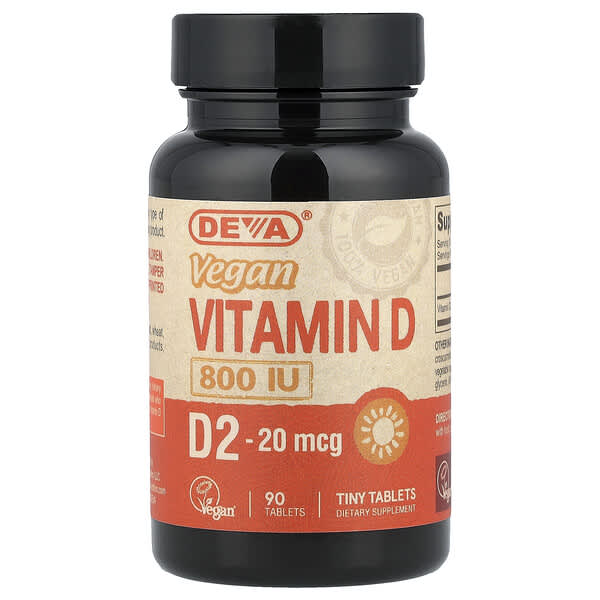
View DEVA Vegan Vitamin D2 details and price
DEVA Vegan Vitamin D3 (90 tablets)
DEVA D3 supplies 25 mcg (1,000 IU) cholecalciferol per tablet and explicitly identifies lichen as its source. Its other ingredients are also labeled non-animal. A reader wanting D3 while maintaining vegan requirements need not automatically switch to D2 to avoid lanolin.
Adult directions specify one tablet daily with food. The 90-tablet pack provides 90 one-tablet servings without drop measuring. It matches the 21st Century softgel’s vitamin D amount per unit, while avoiding that formula’s gelatin and soybean oil, useful when those are specific exclusions.
Cellulose, dicalcium phosphate and other tablet excipients remain in the formula; vegan does not mean a single-ingredient product. Meeting a dietary-source requirement does not predict how much a person’s blood level will rise, or replace an established treatment plan.
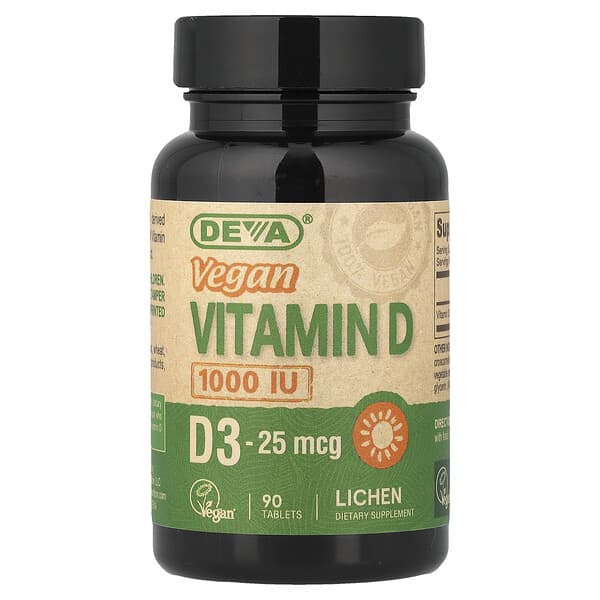
View DEVA Vegan Vitamin D3 details and price
21st Century Vitamin D3 (250 softgels)
21st Century D3 supplies 25 mcg (1,000 IU) per gelatin softgel using soybean oil as the carrier, with adult directions for one daily with a meal. The 250-count pack suits a familiar softgel preference when it can be used within expiry. Compared with a 90-tablet pack, the package distinction is more servings, not greater strength in each unit.
Glycerin and water are also listed. The formula contains soy and is not a vegan option. It lists no added sugar, yeast, preservatives, artificial flavors or colors. If soy or gelatin is an exclusion, DEVA’s lichen D3 provides a concrete alternative formulation to compare.
The oil-based format alone cannot establish better absorption than an equal-amount D3 tablet. Follow its meal directions rather than treating the carrier or larger bottle as a reason to increase the amount.
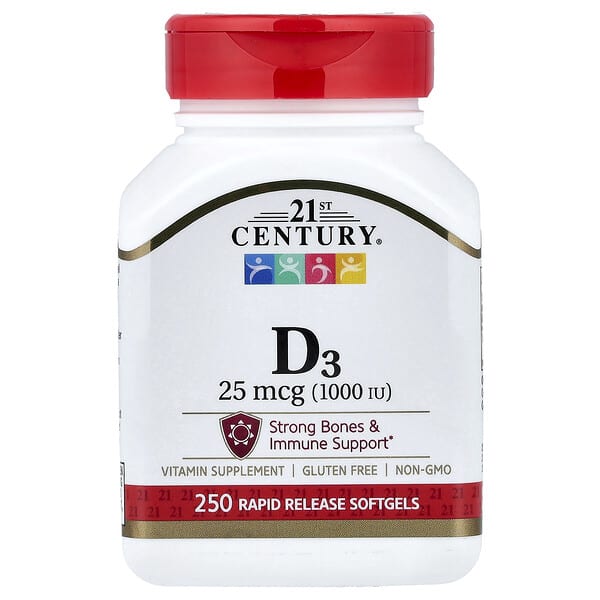
View 21st Century Vitamin D3 details and price
Vegan sourcing and physical format are separate requirements
“D3” identifies the vitamin form without, by itself, establishing an animal or non-animal source. “Softgel” identifies a format without replacing the full ingredient list. Here, DEVA’s lichen D3 meets its vegan positioning, while the equal-strength 21st Century D3 uses gelatin and soybean oil. The nutrient amounts match, but dietary suitability differs.
Conversely, D2’s common association with fungal sources cannot establish that every finished D2 product excludes animal ingredients. The vitamin source and tablet or capsule ingredients both matter. DEVA D2 explicitly identifies non-animal ingredients, so the assessment can be made for that product rather than inferred for an entire category.
Tablets avoid measuring when swallowing them is comfortable. An oil-based softgel is another practical format for someone who accepts soy and gelatin. If neither is manageable, compare a separately verified liquid with clear per-drop or per-milliliter instructions. Do not assume that tablets, capsules or another bottle’s dispensing tip can be used interchangeably simply because the front shows the same IU number.
Separate intake references, package strength and the upper limit
NIH lists an adult reference of 15 mcg (600 IU) daily at ages 19–70 and 20 mcg (800 IU) at 71 and older, including food and supplements if needed. These figures are not an instruction to add the whole amount on top of food or a personal prescription calculated from a blood test. The adult upper limit is 100 mcg (4,000 IU) daily from food and supplements; it is not an everyday target.
For a hypothetical overlap, a multivitamin providing 25 mcg plus a separate 25 mcg D3 tablet contributes 50 mcg (2,000 IU) from supplements, with food additional. This illustrates combined sources rather than recommending the combination. Two bottles each having once-daily instructions does not establish that using both is needed or appropriate.
For package value, DEVA D3 provides 90 times 1,000 IU, totaling 90,000 IU per bottle; 21st Century provides 250,000 IU. Divide bottle price by total IU and multiply by 1,000 to compare cost per 1,000 IU. That common unit does not override ingredient requirements, expiry or actual need, and it cannot select a daily amount.
Vitamin D is not calcium
Vitamin D helps the intestine absorb calcium, but 25 mcg D3 cannot be converted into a calcium amount in milligrams. These three products primarily supplement vitamin D; bone-health wording does not make them calcium tablets. Dicalcium phosphate in DEVA’s ingredient lists is not accompanied by a quantified calcium serving. If both nutrients matter to the purchase, compare separate vitamin D and calcium amounts rather than estimating calcium from an ingredient name. A higher vitamin D strength does not fill an unspecified calcium shortfall.
Does choosing D3 mean testing first or buying a higher strength?
The Endocrine Society’s 2024 disease-prevention guideline advises against routine vitamin D supplementation above established dietary reference intakes, and against routine 25(OH)D testing, in generally healthy adults aged 19–74 without an established indication for treatment or testing. It does not tell someone with diagnosed deficiency or an existing treatment plan to stop it. Pregnancy, ages 75 and older, and other specific situations have separate recommendations. Guideline
Choosing D3 therefore does not mean buying the highest IU strength or pursuing the highest blood-test number. Existing high calcium, kidney disease, medicines or a treatment plan call for review of the suitable product and monitoring requirements. In particular, combining thiazide diuretics with vitamin D can increase the risk of high blood calcium. Switching to D2 does not automatically remove that concern.
Related reading
References
- NIH ODS — Vitamin D health professional fact sheet
- Tripkovic et al., 2017 — PMID 28679555
- Endocrine Society — 2024 Vitamin D for Prevention guideline