
A higher-dose B-complex is not automatically a better choice. If B12 is the nutrient you need, a standalone product is often easier to match to that purpose. If several B vitamins are needed, check that the combination does not add unnecessary B6 or duplicate other products. Liquid does not necessarily mean low-dose.
This guide uses three products to explain actual trade-offs, separating fatigue, vegan diets and preconception needs. Brand claims about energy are not treated as clinical proof.
When is a full B-complex relevant?
- A reliable B12 source: a vegan diet requires a reliable source, such as fortified foods or a B12 supplement. High-B6 combinations are not required just to obtain B12. Diagnosed deficiency needs a clinical plan rather than the ordinary intake reference.
- Restrictions affecting several nutrients: discuss whether a combination helps. B-complex does not supply every mineral or replace a dietary assessment.
- Fatigue alone: poor sleep, stress, anemia and other conditions are possible causes. More B12 is not an energy guarantee when there is no deficiency. Persistent fatigue warrants assessment.
- Preparing for pregnancy: follow applicable folic-acid guidance and professional advice. Ordinary B-complex products are not necessarily appropriate, and some explicitly exclude pregnancy and breastfeeding.
Fatigue and a vegan diet are different starting points
A vegan diet raises a practical question about a reliable B12 source. Tiredness during a period of poor sleep does not by itself establish B12 deficiency. Both can occur together, but they need to be described separately. Before buying, note the eating pattern, existing fortified foods or supplements and how long symptoms have lasted rather than selecting the largest %DV.
With diagnosed deficiency, the cause can change the prescribed amount or route compared with an ordinary nutrition reference. Shopping should then match treatment. A B-complex listing B12 is not automatically a replacement for the existing B12 regimen. The fact that it supplies several other vitamins does not establish that it treats the same problem.
A few numbers that change the purchase
| Nutrient | Adult intake reference / label convention | Practical implication |
|---|---|---|
| B6 | 1.3 mg daily at ages 19–50; slightly higher at older ages | 10 mg is well above a younger adult’s routine need |
| B12 | 2.4 mcg daily; not a deficiency-treatment dose | A 1,000 mcg product does not mean everyone needs that intake |
| Folate | 400 mcg DFE daily for most adults | DFE and the parenthetical ingredient amount describe the same serving |
These are NIH ODS reference values, not personal prescriptions. US %DV is a labeling reference, not an effectiveness score. One milligram equals 1,000 micrograms; B6 and B12 cannot be compared by their numerical size alone.
Why does 2 mg B6 appear as 118% on the label?
The standard US labeling Daily Value for B6 is 1.7 mg. Two milligrams divided by 1.7 is approximately 118%. The 1.3 mg dietary reference for ages 19–50 serves a different purpose. The figures do not contradict each other, and the label does not instruct you to supplement to 118%. For intake planning, use actual milligrams and the appropriate age reference; for product comparisons, use comparable portions. The percentage is not an absorption rate.
Three formulas with different trade-offs
This article contains affiliate links. ToBeHealthy may earn a commission from purchases made through them. Comparisons are based on verified formulations and specifications, without hands-on product testing.
| Product and serving | B6 / B12 / folate | Editorial distinction |
|---|---|---|
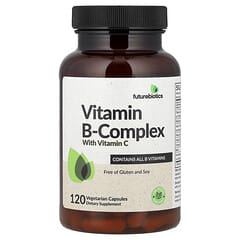 Futurebiotics, 1 capsule | 2 mg / 15 mcg / 666 mcg DFE (400 mcg folic acid) | Eight B vitamins plus 150 mg C, once daily; excludes pregnancy and breastfeeding |
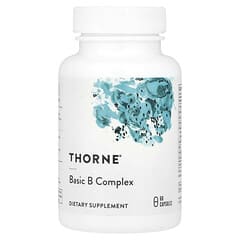 Thorne Basic B Complex, 1 capsule | 10 mg / 400 mcg / 667 mcg DFE (400 mcg L-5-MTHF) | Specified coenzyme forms and choline; higher B6 and niacin require a defined plan |
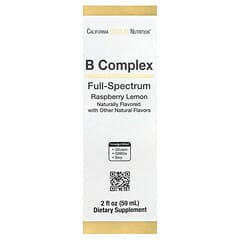 California Gold Nutrition, 25 drops (1 mL) | 2 mg / 1,000 mcg / no listed folate | No capsule swallowing; stevia-sweetened, high B12 and no listed folate |
Futurebiotics B-Complex with Vitamin C, 120 capsules
Futurebiotics combines all eight B vitamins with 150 mg of vitamin C in one vegetarian capsule. Its practical advantage is a once-daily B-plus-C format: the 120-capsule bottle contains 120 servings. For someone with a reason to use several nutrients who wants to avoid a 10 mg B6 formula, its 2 mg B6 amount provides a clearly different comparison point.
- B12 is 15 mcg; folate is 666 mcg DFE: the folate comes from 400 mcg of folic acid. These describe one amount, not two amounts to add.
- Labeled free of gluten and soy: relevant for checking those exclusions. A vegetarian capsule and suitability of the complete formula for a particular diet should still be assessed from the full label.
- One capsule daily, preferably with a meal: no dropper measurement is needed, making it easier to incorporate into a regular meal routine.
Lower B6 does not make every ingredient low-dose. B1 is 50 mg, B2 is 20 mg and niacinamide supplies 25 mg NE. A multivitamin or separate vitamin C can overlap. If an existing formula supplies 90 mg C, adding this 150 mg gives 240 mg from the supplements before food is counted; that is arithmetic, not a suggested stack.
The product explicitly excludes pregnancy and breastfeeding. Its 400 mcg folic acid content therefore should not be used alone to select the whole formula as a preconception or prenatal choice. Its clearer position is a general-adult B-plus-C combination within the complete product warnings.
View Futurebiotics B-Complex with Vitamin C, 120 capsules details and price
Thorne Basic B Complex, 60 capsules
Thorne Basic B Complex puts eight B vitamins and 28 mg of choline into one capsule. It identifies P-5-P B6, methylcobalamin B12, Quatrefolic® L-5-MTHF folate and riboflavin 5′-phosphate sodium. Someone whose established supplementation plan requires those forms can match names and amounts directly; the names do not establish a stronger energy effect.
Each capsule provides 400 mcg B12 and 667 mcg DFE folate, labeled as 400 mcg L-5-MTHF. B5 is 110 mg, compared with 5.5 mg in Futurebiotics and 30 mg in the liquid formula. These differences show that this is a change in several nutrient amounts, not simply a brand substitution. A reason to choose it should concern the complete formula fitting a need rather than one number being the largest.
The main limitation is 10 mg B6 per capsule, close to EFSA’s 12 mg adult total-intake upper level. Niacin totals 140 mg, comprising 130 mg niacinamide and 10 mg nicotinic acid. Different forms have different adverse-effect profiles, so coenzyme or active terminology should not replace an amount review.
The 60-capsule bottle has 60 one-capsule servings. Directions allow one capsule one to three times daily or professional advice; they do not establish that everyone should use the maximum. Three daily capsules would supply 30 mg B6 before other sources. That calculation is a reason to review the intended regimen, not a recommendation for that frequency.
View Thorne Basic B Complex, 60 capsules details and price
California Gold Nutrition Liquid B Complex, 59 mL
California Gold Nutrition’s raspberry-lemon liquid avoids swallowing capsules and is labeled suitable for vegans. Its base includes vegetable glycerin, water, natural flavor, lemon essential oil and stevia leaf extract. Someone preferring an unflavored formula may want to compare another option.
Each 25 drops, or 1 mL, provides 2 mg B6 and 1,000 mcg B12; the 59 mL bottle contains 59 servings. B1 is 1.5 mg and B2 is 1.7 mg, closer to ordinary labeling reference amounts than the larger capsule formulas. B12 nevertheless remains high, so liquid should not be interpreted as a uniformly low-dose format.
Directions specify shaking before each use and taking 25 drops once daily with food. The formula contains seven B vitamins without listed folate. It therefore cannot complete a preconception folic-acid requirement or another specified folate plan. Its purchasing distinction is format, not proof that it energizes faster than capsules.
Recheck drops or milliliters per serving on a brand change. This bottle’s 25-drops-per-milliliter statement cannot be transferred to another dropper. Taking fewer drops to reduce only B12 also changes the amounts of the other six vitamins. If B12 needs independent adjustment, compare a standalone plan instead of treating a complex’s drop count as a way to change just one ingredient. The quantity, number of nutrients and measurement method all matter to whether this format is convenient.
View California Gold Nutrition Liquid B Complex, 59 mL details and price
Count B6 even when the label says P-5-P
Excess supplemental B6 over time can cause peripheral neuropathy, with tingling, burning or numbness. Australia’s TGA reports cases involving less than 50 mg daily and multiple overlapping products. One bottle’s amount is therefore not the whole exposure. TGA safety information
A B-complex with 10 mg, a magnesium formula with 5 mg and a multivitamin with 2 mg total 17 mg supplemental B6 before food. EFSA’s adult upper level is 12 mg daily; the US Food and Nutrition Board uses 100 mg. These reflect different assessments, and the higher number does not prove that everyone is safe below 100 mg. P-5-P still counts as B6.
For tingling, burning or numbness, stop a suspected nonprescription B6 supplement and seek medical advice promptly, bringing all products. Other causes also need consideration.
Niacinamide and nicotinic acid are not identical label descriptions
All three formulas supply B3, but the forms and amounts differ: Futurebiotics uses 25 mg NE as niacinamide, the liquid uses 20 mg niacinamide, and Thorne combines 130 mg niacinamide with 10 mg nicotinic acid. Keep the form with the number rather than reducing the comparison to high or low B3.
Their adverse-effect profiles are not identical. Nicotinic acid is more associated with flushing; niacinamide does not usually cause that type of flushing, without making high amounts irrelevant. This does not predict that a particular bottle will cause symptoms. It explains what changes when switching formulas, so a B-complex name is not used to treat different strengths as interchangeable.
Are active B12 and folate worth a premium?
NIH ODS reports no evidence that supplement B12 absorption differs by form. Methylcobalamin’s name alone does not establish better clinical outcomes. For a reliable B12 source, purpose, amount and consistent use matter more than the name.
Folate requires attention to the exact form. About 667 mcg DFE and the parenthetical 400 mcg folic acid or L-5-MTHF are not separate amounts to add. For preconception, follow applicable guidance rather than replacing recommended folic acid simply because another label says “active.”
High folate intake can correct anemia caused by B12 deficiency without preventing neurological damage. Tell the clinician investigating possible B12 deficiency about folate and complete combination products; an improved blood picture does not by itself resolve the concern.
Why a preconception choice needs more than a DFE number
Hong Kong Family Health Service preconception information advises at least 400 mcg supplemental folic acid daily when planning pregnancy and during the first trimester, generally not exceeding 1,000 mcg; an existing clinician-directed regimen needs individual review. A product must also fit the intended population, form and healthcare plan; finding the number 400 alone is not enough.
The three products have different limitations. Futurebiotics contains 400 mcg folic acid but explicitly excludes pregnancy and breastfeeding. Thorne uses L-5-MTHF and instructs pregnant users to consult a practitioner. The liquid does not list folate. These are not three interchangeable prenatal products.
If a prenatal combination is already in use, review that formula before adding another bottle. DFE is a folate labeling reference; the figures here follow each product’s own panel, rather than applying an invented conversion to every folate form. Tell the clinician which form and complete combination are being considered so the advice addresses the actual product.
Capsule count alone is not cost per serving
Futurebiotics contains 120 servings, Thorne 60 one-capsule servings and the liquid 59 one-milliliter servings. Divide the actual checkout price by 120, 60 or 59 respectively to compare labeled serving cost. No changing retail prices or unverified discounts are inserted here.
This arithmetic compares package portions; it does not make the three formulas nutritionally equivalent. Actual daily frequency, duplication of an existing product and whether the formula is needed affect total spending. If only B12 is required, a B-complex being cheaper per serving could still add unwanted ingredients. The appropriate comparison is the cost of following a defined supplementation plan, not the largest bottle or highest B12 number.
Make the decision in this order
- Establish whether the need is B12, folate or several nutrients.
- Add up B6 from existing formulas and review other high amounts, including niacin.
- Choose a usable capsule or liquid without losing the nutrient actually needed.
- Compare actual cost and servings. The largest B12 number is not automatically the best value.
Medication use, pregnancy planning, diagnosed deficiency and persistent neurological symptoms need a suitable clinical supplementation plan.
References
- NIH ODS — Vitamin B6
- NIH ODS — Vitamin B12
- NIH ODS — Folate
- NIH ODS — Niacin
- TGA — supplementary vitamin B6 and peripheral neuropathy
Related reading
- multivitamin label guide
- How Much Iron Do Adults Need? Intake by Life Stage
- Daily Vitamin C Intake: Is 1,000 mg Necessary?