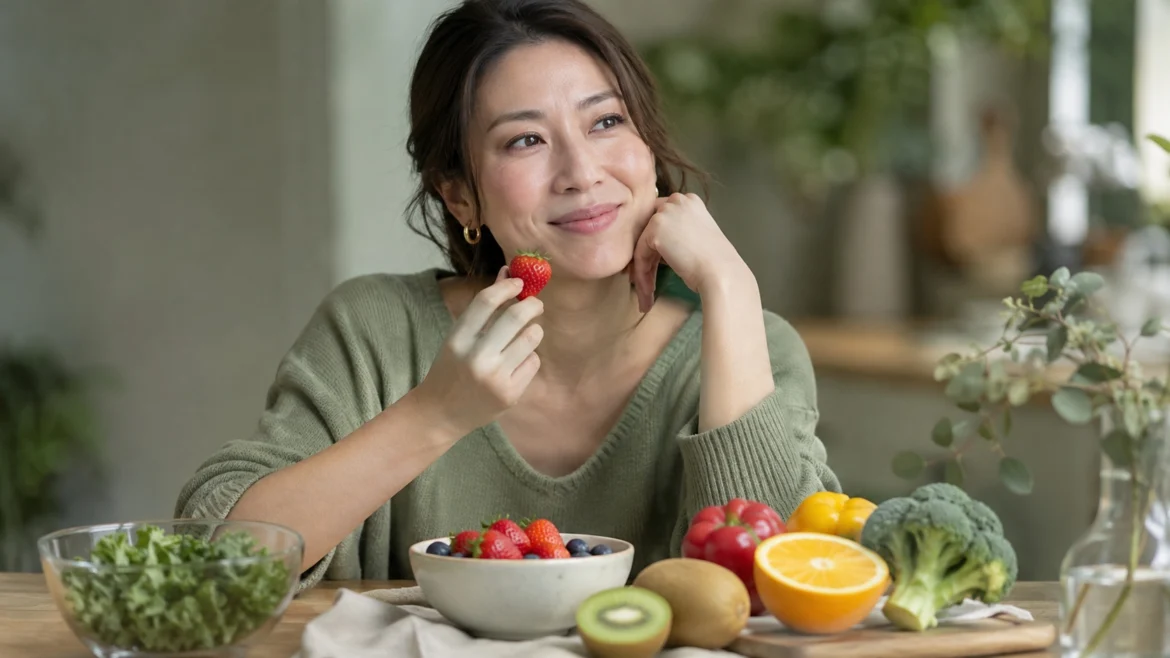
Oranges, kiwifruit, strawberries, sweet peppers and broccoli all provide vitamin C. In a reference food table, half a cup of raw red sweet pepper contains about 95 mg, a medium orange about 70 mg and half a cup of cooked broccoli about 51 mg. If you want to estimate how much you get in a meal, start with the portions in the table and adjust them to the amount you actually eat.
How much vitamin C is in a serving of fruit or vegetables?
| Food and portion | Vitamin C (approximate mg) |
|---|---|
| Raw red sweet pepper, half a cup | 95 |
| One medium orange | 70 |
| One medium kiwifruit | 64 |
| Raw green sweet pepper, half a cup | 60 |
| Cooked broccoli, half a cup | 51 |
| Sliced fresh strawberries, half a cup | 49 |
The table uses reference servings from the NIH Office of Dietary Supplements. Some rows describe one medium fruit, while others describe half a cup. The numbers help you estimate what you might consume from those portions. They cannot rank the foods by how much vitamin C they contain per 100 g. Variety, size and storage can also affect the actual amount in your food.
Half a cup, one fruit and 100 grams do not form one ranking
Half a cup of raw red pepper providing 95 mg contributes more than the table’s medium orange at 70 mg. That compares those two portions; it is not a ranking per 100 grams. If a sandwich contains only two pepper strips but you eat a whole orange, your actual contributions need not follow the table’s portion comparison.
For everyday decisions, compare the amounts you would comfortably finish rather than forcing every food into a 100-gram portion. A quarter cup of sliced strawberries on breakfast yogurt provides about 24.5 mg using the half-cup value of 49 mg, reasonably recorded as about 25 mg. Add a medium orange and the two contribute roughly 95 mg. This illustrates portion arithmetic, not a requirement to use a measuring cup for every meal.
The table identifies meaningful sources; differences of a few milligrams should not become a shopping competition. When you would eat either fruit, price, portion, storage and preference can determine which one actually becomes part of the diet. A high-content fruit left uneaten is less useful than an acceptable source you finish regularly.
This table expresses vitamin C in milligrams, abbreviated mg. If another source uses grams, one gram equals 1,000 mg. Do not apply the IU conversion used for vitamin D to this vitamin C food table.
What would another serving add to lunch?
If lunch already includes half a cup of cooked broccoli, adding a medium kiwifruit gives you about 115 mg across the two items. If you eat half the kiwifruit, the estimated total is 83 mg. This is a way to compare the portions you actually serve. Both figures cover only those two foods, before counting anything else you eat that day.
If you do not like oranges, compare options such as kiwifruit and strawberries. First consider how much you usually eat. One medium kiwifruit and half a cup of sliced strawberries describe two different servings. If you put just a few slices of strawberry on yoghurt, use a smaller estimate than the half-cup figure.
Do cooked vegetables still provide vitamin C?
Yes. The broccoli entry uses cooked-food data; the following section explains how preparation and reference values fit together.
Keeping vitamin C does not require abandoning cooked vegetables
The Hong Kong Centre for Food Safety study of fruit and vegetable nutrients explains that some vitamin C can pass into boiling water. Steaming or a shorter stir-fry can reduce unnecessary prolonged heating and contact with large volumes of water. The method’s name alone, however, cannot guarantee one retention percentage for every dish.
Nutrition and food safety need to be considered together. Do not undercook food that needs thorough cooking to preserve a raw-food figure. Equally, a day when cooked vegetables are the convenient option is not a day with no vitamin C. The cooked broccoli entry already demonstrates a contribution from cooked food.
Raw-weight and cooked-weight entries also differ in portion and preparation; water loss changes how a weight comparison works. Estimating cooking loss needs matched foods and conditions, not the difference between raw pepper and cooked broccoli. For a meal record, use the figure matching the way the food is eaten. Do not then subtract another assumed half for cooking when the reference already describes cooked food.
Choose by how you eat
| Need | Food option | Practical reason |
|---|---|---|
| No cooking equipment | Orange or kiwifruit | A separate fruit portion avoids relying on a tiny garnish |
| Hot packed meal | Cooked broccoli | Still provides vitamin C; use the cooked portion reference |
| Yogurt or oats topping | Sliced strawberries | A quarter cup provides about 25 mg |
| Prefer less-sweet foods | Peppers in salads or meals | Half a cup raw red pepper provides about 95 mg; cooked forms need matching data |
Juice versus fruit-flavored drinks
Orange flavor does not establish vitamin C. Compare actual milligrams at the same drinking volume, with sugar and fiber separately. Ascorbic acid in an ingredient list without an amount cannot yield an invented per-cup figure. Whole-fruit figures and juice figures also differ.
Calculate a drink from the volume consumed
Suppose a drink lists 30 mg of vitamin C per 100 mL. Drinking 250 mL supplies 75 mg, while 100 mL supplies 30 mg. If another column states a 250 mL serving, check that the columns describe the corresponding portions and use one calculation. Adding the per-100-mL and per-serving columns together would count the same drink twice.
This is a hypothetical label example, not a juice specification. Orange flavor, the presence of some juice or the drink’s color cannot replace a quantified amount. “Vitamin C added” also needs an amount per serving before it can support a reliable nutrient comparison.
A juice and a whole fruit providing similar vitamin C do not therefore have identical overall nutrition. Fiber, sugar and actual drinking volume remain separate considerations. Convenience can be a reason to choose a drink, but there is no need to drink an unwanted large portion simply to obtain vitamin C. The whole fruits and vegetables in the table provide other practical ways to include it.
How food compares with daily needs
Adult references are 90 mg for men and 75 mg for women, with 35 mg more for smokers. Half an orange at lunch gives about 35 mg and half a cup cooked broccoli at dinner about 51 mg: roughly 86 mg before other foods. Ordinary fruit and vegetables make meaningful contributions without requiring a high-dose tablet.
Why include vitamin C foods with a bean-based meal?
Vitamin C improves absorption of nonheme iron, the form found in plant foods and iron-fortified foods. With a bean-based main dish, peppers can be part of the meal, or an orange or kiwifruit can be the fruit course. This gives a specific reason for the pairing without turning the meal into a high-dose supplement stack.
For example, adding peppers to a bean-and-rice meal retains the main dish while supplying a vitamin C source. It does not tell you exactly how much iron the person absorbs or guarantee improvement in anemia. Someone with diagnosed iron deficiency still needs their treatment plan; fruit should not independently replace prescribed iron.
Iron sources also differ between animal and plant foods. The linked iron-rich foods guide addresses those distinctions. A useful nutrient interaction is not an instruction that every reader buy both an iron bottle and a vitamin C bottle. The practical food pairing can be considered within an ordinary diet without inventing an absorption percentage for that plate.
For the food-source comparison, see Iron-Rich Foods: Meat, Beans and Fortified Foods.
Taking fruit to class or work also involves safe storage
The Centre for Food Safety guidance on pre-cut fruit advises washing fruit thoroughly under running water before peeling or cutting. Use separate equipment for ready-to-eat produce and raw foods such as meat to prevent cross-contamination. Keep cut fruit refrigerated at 4°C or below and do not leave it above 4°C for more than two hours.
If refrigeration is unavailable that day, an uncut orange that can be washed and peeled before eating may be easier to manage than fruit cut at breakfast and carried in a bag all day. Perishable fruit such as strawberries and ready-made fruit boxes require attention to chilling, rather than selection only by their vitamin C number.
Poor storage is a food safety issue. Normal appearance or an assumption that vitamin C remains cannot establish that a fruit box is safe. A nutrient table does not provide a room-temperature shelf life for a particular container. Storage, transport and eating time still have to be planned. Convenience means the food can be kept and eaten appropriately, not only that it was already sliced when purchased.
Count your share of a family vegetable dish
Suppose a dish contains two cups of cooked broccoli: four half-cup portions. Using about 51 mg per half cup gives roughly 204 mg for the dish. If four people share it equally, each receives about 51 mg, not 204 mg each. This uses one reference value to demonstrate sharing; it is not a laboratory measurement of a home-cooked dish.
A food record can retain that reasonable estimate without calculating every meal to a decimal place. Distinguishing the whole dish from a personal portion, known amounts from uncertain entries and food served from food actually eaten matters more than apparent precision to one milligram.
Where can you check foods missing from this short list?
Choy sum, bok choy and other vegetables you regularly eat are not absent sources merely because they are missing from a short table. The Centre for Food Safety Nutrient Information Inquiry system includes vitamin C information and can be searched for matching food entries. Keep the food name, raw or cooked condition, portion unit and source with the number so the context is not lost next time.
If an entry lists an amount per 100 grams and your matching portion is about 50 grams, use half of that amount as an estimate. The food and preparation still need to match. When a cooked entry is unavailable, a raw-food value should not be presented as an exact measurement of a cooked dish. A similar food can inform an estimate, but it should not silently become a confirmed figure for another item.
Frozen and canned versions likewise need corresponding information or their own package values rather than automatically inheriting the fresh raw-food figure. Their convenience for storage and portion management is a separate question from the nutrient amount. For an item without confirmable information, keep the amount unconfirmed. Do not fill a missing entry with zero or an invented figure simply to make the calculation look complete.
Does a sour taste or bright color measure vitamin C?
Taste and color cannot supply a vitamin C amount in milligrams. Red pepper, kiwifruit and oranges can all contribute, so the choice need not be limited to the sourest fruit. For someone who dislikes one option, an acceptable fruit or vegetable can be more sustainable than forcing the same sour drink every day. Use matching portion information for the amount rather than treating taste as a nutrient test. This also leaves room for vegetables to contribute when a sweet fruit is not wanted.
Enough vitamin C does not establish enough fruit and vegetables overall
Half a cup of red pepper can make a substantial vitamin C contribution. Reaching a nutrient reference with that item does not establish that no other fruit or vegetables are needed. Hong Kong Department of Health guidance for adults recommends at least two servings of fruit and three of vegetables daily, with variety. That concerns a broader dietary pattern rather than a milligram target for one vitamin.
If dinner already contains peppers, fruit can still have a place in the overall pattern; it does not need to be canceled because the vitamin C subtotal looks adequate. Nor should the menu become progressively narrower to repeat the same high-vitamin-C food daily. Preferences, availability and preparation can change while maintaining useful sources. The calculation helps identify contributions, rather than requiring each meal to become a precisely formulated recipe.
The half-cup measure in a nutrient table also is not necessarily the serving definition used in every dietary guideline. It describes the amount attached to that nutrient figure. When following a pattern such as two-plus-three, consult that guidance’s portion definitions instead of treating every row in this article as an equivalent serving. A medium fruit and a half cup of sliced vegetables can be useful nutrient examples without representing an interchangeable unit for every purpose.
Related reading and sources
- vitamin C supplement forms comparison
- NIH Office of Dietary Supplements food sources and reference intakes for vitamin C
- Daily Vitamin C Intake: Is 1,000 mg Necessary?