
If you’re choosing skincare for sensitive skin, start with the full ingredient list and directions. Check what fragrance-free, unscented or hypoallergenic means for the product you’re holding, and look for any ingredient you already know causes a reaction.
What the front of the package tells you
| Claim | What it generally tells you | What to verify |
|---|---|---|
| Fragrance-free | The maker is presenting the product as free of added fragrance. | Read the full list for fragrance and any individual ingredients you need to avoid. Ask the maker if a specific allergen is unclear. |
| Unscented | The product is intended to have little or no noticeable smell. | Some formulas use ingredients to mask odor. Check the ingredient list rather than relying on how the product smells. |
| Hypoallergenic | The maker is making a claim about allergy risk. | In the United States, FDA does not set a federal definition or testing standard for this cosmetics claim. Look for what was actually tested. |
| Dermatologist-tested | The maker says a dermatologist was involved in testing. | Check how the study was run, who took part, and what result the claim refers to. |
| Alcohol-free | On U.S. cosmetics, this usually refers to ethyl alcohol. | Compare the exact ingredient names, especially Alcohol, Ethanol, or Alcohol Denat. |
| For sensitive skin | The maker describes the audience for the product. | Check your known triggers and the directions for the intended area. |
A product can have a faint smell from its ingredients even if the brand calls it fragrance-free. A product that smells like nothing might be described as unscented. Both observations are separate from whether a specific fragrance component appears in the formula. If your dermatologist gave you a list of ingredients to avoid, start there. When a label uses the collective word “fragrance,” the individual ingredients in that mixture may not all be named. Contacting the manufacturer can help when you need a specific answer.
If you cannot name the ingredient that caused an earlier problem, keep a record of the products and where you used them. A photo of the back label is useful when the bottle is empty or the formula changes. Try looking for an exact common ingredient across products you reacted to, keeping in mind that the pattern is a clue for a clinician. It cannot provide a diagnosis on its own.
Read the ingredient list without guessing percentages
In the U.S., cosmetic ingredients generally appear in descending order of predominance. Ingredients at 1% or less may appear in any order after the ingredients above 1%, with separate rules for color additives. The list usually does not show you where the 1% group begins. The order can help you recognize a general formula pattern, but it cannot tell you the exact amount of fragrance or how two products compare by the amount of an ingredient.
Read the complete chemical name when a word looks familiar. Alcohol Denat. means denatured alcohol. Cetyl alcohol and cetearyl alcohol are fatty alcohols often used in creams and lotions to change texture or help keep the mixture uniform. If you are specifically avoiding ethyl alcohol, look for the relevant names. If you have had a reaction to an identified fatty alcohol, check for that exact ingredient instead.
For a product you bought online, match the back-label photo to the exact name, size, and package version. A promotional photograph can show an old label, a travel format, or a regional version. When the online description and the box differ, use the information on the package you have and ask the manufacturer if a relevant ingredient is unclear. If a label highlights a single ingredient on the front, see how that ingredient fits into the rest of the formula before you decide.
Walk through three products you use differently
| Product | Look for first | Practical comparison |
|---|---|---|
| Moisturizer | Fragrance wording, ingredients you know you tolerate, and the intended area | A cream and lotion can share ingredient names and still spread differently. Compare the texture and the full lists. |
| Cleanser | Whether it rinses off, the directions for use, and ingredients you need to avoid | Foam, gel, and cream describe the format. The directions and your experience after rinsing help you compare them. |
| Sunscreen | SPF, broad-spectrum claim, explicit water-resistance label if needed, and active filters | Match the package version and read the active and inactive panels if it has Drug Facts. |
A moisturizer stays on the skin
Imagine a cream that says “fragrance-free” and lists glycerin, petrolatum, and cetearyl alcohol. The fragrance claim is relevant if your concern is added fragrance. If you want to avoid ethanol, look for the exact ethanol-related names before deciding. Cetearyl alcohol alone does not identify ethanol. Glycerin and petrolatum give you more context about the types of moisturizing ingredients, while the packaging still cannot tell you how thick or sticky the cream will feel to you.
Now compare it with a gel that says “suitable for sensitive skin.” It might have a lighter feel for someone who dislikes using a cream over a large area. Start with the area you want to moisturize and compare what you know about the formulas. For example, you might be happy using a cream on rough-feeling hands but prefer a lighter formula on your face under sunscreen. The label question is whether both products match your known ingredient restrictions. The use question is whether you are comfortable applying them where you need them. The face moisturizer comparison illustrates how creams, lotions, and gels can differ.
A cleanser gets rinsed off
Imagine a foaming cleanser that says “hypoallergenic,” but the ingredient panel lists parfum. If you are avoiding added fragrance, that full ingredient list provides a clearer answer than the front claim. If fragrance is not one of your concerns, continue reading. Check where the cleanser is meant to be used, whether it is designed to remove sunscreen or makeup, and how the label tells you to rinse it.
To compare two cleansers at home, use each only as directed. Keep water temperature and the rest of your routine similar, and see whether your skin regularly feels tight immediately after washing. Keep in mind that scrubbing, hot water, or a second cleansing step can also change how your skin feels. A rinse-off product with a comfortable texture can still cause a reaction for someone who is sensitive to an ingredient. The gentle facial cleanser guide gives examples across gel, cream, and foam formats.
A sunscreen needs a protection check first
If you are comparing sunscreens, start with the protection you need. AAD recommends broad-spectrum SPF 30 or higher and water resistance. U.S. sunscreens may list water resistance for 40 or 80 minutes. For a label from another market, read the protection indicators used on that package and check whether it has its own explicit water-resistance statement. The brand name or bottle color may remain similar while filter names and claims change. This matters if you found a familiar product online that is shipped from a different market.
Next, read the active ingredients and the rest of the formula. In a U.S. Drug Facts panel, the active filter list is separate from inactive ingredients. A zinc oxide product still has a base with other ingredients. If you want to avoid a fragrance or a particular plant oil, look beyond the filters. Likewise, a label saying “mineral” tells you something about the filters, while the separate broad-spectrum, SPF, and water-resistance claims tell you about the stated protection. Check all of those details on the actual package. The Korean sunscreen guide shows version and filter examples.
A worked example with two sunscreen packages
Suppose one tube says “Broad Spectrum SPF 50” and lists water resistance for 80 minutes. Another says “SPF 50+ PA++++” and has no water-resistance claim you can find. That gives you two different pieces of label information. For an afternoon that includes swimming, the first package gives a specific water-resistance claim to follow. You would still need to read its directions, including when to apply it again after swimming or towel drying. For the second, check the exact product’s instructions before deciding it fits that activity.
If both packages meet the protection needs for your planned use, compare the ingredients you may want to avoid and the formula you can apply as directed. For example, a concern about added fragrance does not require you to choose between a particular mineral or organic filter on the front. Check the full formula, including the inactive ingredients, for the exact items you wish to avoid. A product that works for one person can be uncomfortable for another, even when both people choose the same SPF.
Three Sensitive-Skin Labels to Compare by Routine Step
Pick the step you are changing: a rinse-off cleanser, a leave-on moisturizer, or sunscreen. Use the labels to screen for known ingredients of concern.
| Product | When to compare it |
|---|---|
 Vanicream Fragrance-Free Facial Cleanser (237 mL) | A fragrance-free cleanser to rinse off. |
 Vanicream Daily Facial Moisturizer (89 mL) | A fragrance-free moisturizer to leave on after washing. |
 Vanicream Zinc Oxide Facial Sunscreen SPF 30 (71 g) | A daytime sunscreen labeled broad spectrum SPF 30. |
Vanicream Fragrance-Free Facial Cleanser (237 mL)

If you want a fragrance-free face wash, look for the 237 mL bottle labeled Gentle Facial Cleanser. This is the rinse-off step. The name and bottle size distinguish it from the brand’s facial moisturizer.
- The cleanser is labeled fragrance-free and lists glycerin and coco-glucoside.
- Pay attention to the way your skin feels after rinsing, especially if you are changing a cleanser you already tolerate.
View Vanicream Fragrance-Free Facial Cleanser details and price
Vanicream Daily Facial Moisturizer (89 mL)
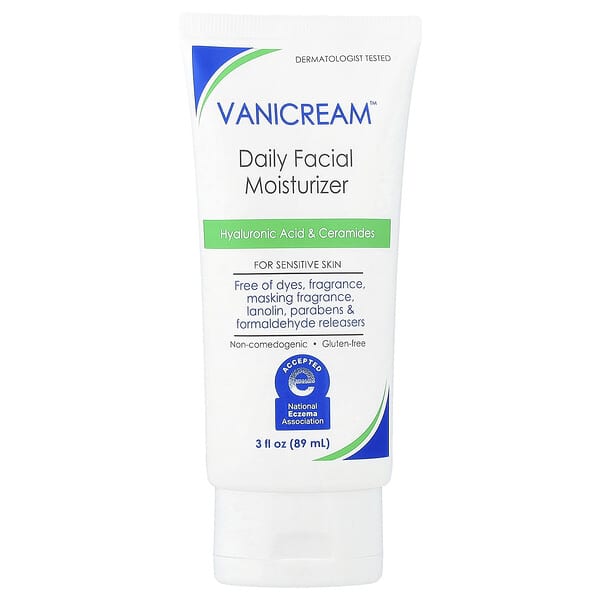
If you want a fragrance-free lotion to leave on after washing, compare this 89 mL facial moisturizer. It lists hyaluronic acid and ceramides. Use the full ingredient list to check for anything you personally need to avoid.
- The formula lists squalane, glycerin, hyaluronic acid, and several ceramides.
- A fragrance-free label is one screening criterion. It does not establish individual tolerance.
View Vanicream Daily Facial Moisturizer details and price
Vanicream Zinc Oxide Facial Sunscreen SPF 30 (71 g)
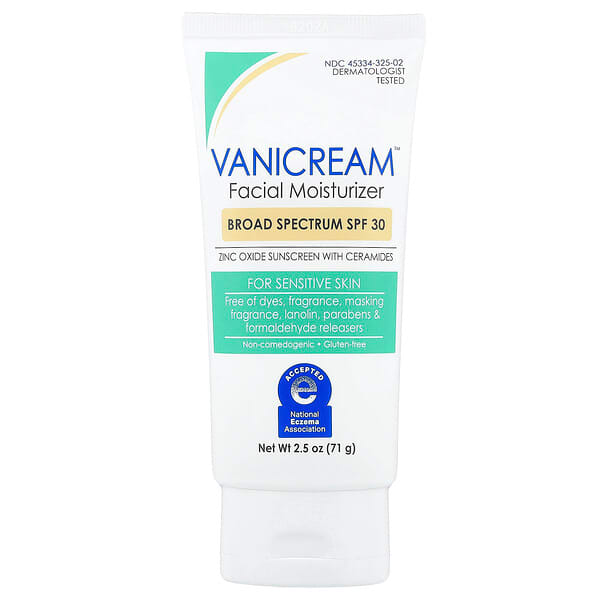
If you’re shopping for daytime sun protection, look for Broad Spectrum SPF 30 on this 71 g tube. The active ingredient is 19.5% zinc oxide. If you intended to buy the everyday facial moisturizer, look for the separate 89 mL tube.
- The product lists broad-spectrum SPF 30 and zinc oxide as its sunscreen active.
- Use the exact tube to assess whether protection and wear directions fit your daytime activity.
View Vanicream Zinc Oxide Facial Sunscreen SPF 30 details and price
Try one new product at a time
A small-area trial is a way to observe how your skin responds to a specific product before using it more widely. The American Academy of Dermatology suggests testing a small spot such as the inside of your arm or the bend of your elbow. Use the amount and contact time you would normally use. If a product is meant to be rinsed off, follow the directions and remove it. A product that limits the application area or frequency should also be used within those instructions.
If you have bought a moisturizer, cleanser, and sunscreen together, introducing all three the same morning makes it harder to separate the effects. Start with the one step you need to replace, while keeping products you already tolerate in place. Check both when you notice a reaction and how long it lasts. For example, a tight feeling immediately after a wash may be worth noting separately from redness or itching later in the day. Record where it occurred and photograph the ingredient panel.
If you develop itching, swelling, redness, or burning after applying a product, gently remove it if appropriate and stop using it. Continued symptoms, a marked reaction, or recurring problems after different products are reasons to consult a dermatologist. A simple note with the date, products used, application area, and change you noticed can help the clinician. Bring the actual packaging or photos if a retailer and brand show different formulas.
Sometimes the choice is which product to try first. If a cleanser has run out and your current sunscreen still feels comfortable, focus on the cleanser. If you are replacing a sunscreen, keep using the one you already tolerate until you have a suitable replacement, where available. That makes it easier to attribute a new reaction. A small-area trial can fit around your usual routine without asking you to stop everyday sun protection.
What a home observation can tell you
A home trial can help you decide whether to continue with a specific product. It cannot isolate all of its ingredients. If you react to a moisturizer that has two ingredients in common with another formula, that resemblance gives you something to discuss. It does not establish which ingredient caused the problem or whether a particular ingredient concentration mattered. Consider other products used on the same area, including medication or a cosmetic applied immediately before it.
Medical patch testing answers a different question. A clinician selects substances and reads the skin’s response to help identify contact allergens. Bring a list of your products when you ask about it. A full history includes products used intermittently, such as a weekend sunscreen or a hair product that runs onto the face in the shower. It also helps to distinguish products used directly on the area from products that may have touched it during application elsewhere.
Before an appointment, collect the information the packaging can still answer reliably. Note the full product name and any distinguishing words such as “daily,” “mineral,” “gel,” or “night.” Include a photo of the lot number if you can find it, especially if a product has been reformulated. Write down whether you used it once, over a few days, or after adding another product. A dermatologist can use that information alongside the history and examination. The record also helps if you need to ask the manufacturer whether a formula with a similar name is the same one.
Sensitive skin label FAQs
Is fragrance-free the same as unscented?
Fragrance-free usually describes how a formula is marketed. Unscented describes the intended lack of an obvious smell. Some unscented products can use ingredients to cover an odor. If a specific fragrance ingredient matters to you, check its name or ask the manufacturer about it.
Does hypoallergenic mean the product is safe for me?
For U.S. cosmetics there is no federal standard for that claim. If a brand gives testing details, see who was tested and what the study measured. Then compare the ingredients with your own history and any guidance from your dermatologist. A group’s experience does not tell you whether you will tolerate the product.
Can I tell whether an ingredient is below 1% from its position?
Usually you cannot find the 1% cutoff by reading the list. Low-concentration ingredients can have flexibility in their order under U.S. rules. Ingredient position alone also cannot tell you whether there is enough of a substance to trigger a reaction for you.
Is a mineral sunscreen always better for sensitive skin?
Mineral filters describe part of the formula. Check the protection claims and any inactive ingredients you want to avoid. Then consider whether you can comfortably apply and reapply enough of the sunscreen. Someone who has reacted to several options can ask a dermatologist for help.
What if the manufacturer updated the package?
Look for the full name, capacity, and ingredient list on the package you are buying. If you want to keep a product you tolerate, save a photo of the back before throwing out the old package. Compare the lists before assuming a new bottle has the same formulation.
Does a product need to foam to clean?
Use the cleanser according to its label. Foam, gel, and cream can be different ways of delivering a cleanser. A product’s amount of foam will not tell you whether it removes a particular sunscreen or makeup. Check the intended purpose and pay attention to how your skin feels after rinsing.
Can a botanical extract have fragrance ingredients?
Plant-derived ingredients may have an odor and some contain fragrance compounds. Read the exact botanical name and keep known triggers in mind. A label may carry a fragrance-free claim while still containing a plant extract, so ask the manufacturer when a specific constituent matters.