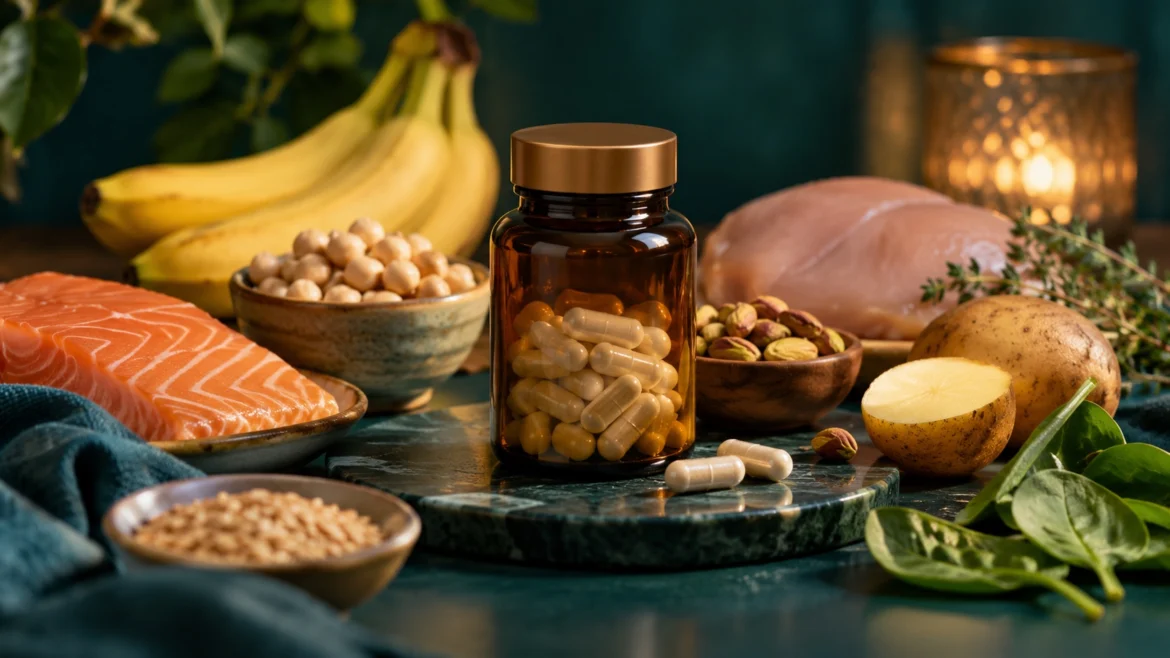
Vitamin B6 helps the body metabolise amino acids, make certain neurotransmitters and form haemoglobin. The US reference intake for adults aged 19 to 50 is 1.3 mg per day. That is an intake from the day’s food and any supplements, separate from the amount in a tablet. If you use a multivitamin, a magnesium blend or a B-complex product, read all the labels before adding another source. Some products contain B6 even though it is not the main ingredient advertised on the front.
What does the body use vitamin B6 for?
The body converts forms of vitamin B6 into compounds that help enzymes carry out reactions. These include reactions in amino acid metabolism and in the formation of neurotransmitters and haemoglobin. Those roles explain why the diet needs to supply enough of the vitamin. They do not show that a person with adequate intake will improve mood, attention or sleep by taking more. The evidence for an ingredient’s role in the body answers a different question from whether starting a supplement will help with a symptom. NIH Office of Dietary Supplements information on vitamin B6
Adult intake references and upper limits
| Reference | Daily amount | How to interpret it |
|---|---|---|
| US recommended dietary allowance, adults aged 19 to 50 | 1.3 mg | Total intake through food, drinks and any supplements |
| US recommended dietary allowance, adults 51 and older | 1.7 mg for men and 1.5 mg for women | Daily nutritional references, with different amounts by age and sex |
| European Food Safety Authority upper limit for adults | 12 mg | An upper limit covering dietary sources, including supplements |
| US upper limit for adults | 100 mg | A US reference figure. It cannot establish that a particular intake is safe for an individual. |
In the US framework, the recommended intake is 1.9 mg during pregnancy and 2.0 mg during breastfeeding. Ask about any supplements you have been advised to use rather than choosing a dose from this table. The upper limits come from different assessments of evidence and uncertainty. They are not goals for intake and do not tell you what a product is allowed to contain in Hong Kong. NIH intake standards and upper limits EFSA opinion on the upper intake level
Where can you get B6 from food?
Fish, poultry, chickpeas, potatoes and some fortified breakfast cereals can provide B6. If you want to count a food from a label, check whether it gives the amount per serving, per 100 grams or per package. Some foods contain the vitamin naturally and others have it added. Both contribute to intake. If the front of a package mentions nutrition without giving an amount, check the panel or a reliable food composition source before estimating.
A meal can make use of foods you already have. For example, a lunch with chickpeas and potatoes has two foods from the list. Someone who eats fish or poultry may prefer to use one of those as part of an ordinary meal. The foods provide several nutrients and vary in their B6 content. You do not need to recreate a supplement dose with one food. Choose food sources that make sense for your meals and check amounts only when you need the detail.
B-complex, magnesium and multivitamins can overlap
A hypothetical multivitamin providing 2 mg, magnesium blend 4 mg and B-complex 5 mg totals 11 mg that day before food. These are example amounts, not a dose recommendation or an allowance to fill the gap beneath an upper limit.
Check the serving count and actual use. Ingredients may say pyridoxine hydrochloride or pyridoxal-5-phosphate. Where the nutrition panel already gives B6, do not add its parenthetical source as a second amount.
Do not wait for an upper limit before addressing nerve symptoms
Australia’s TGA received reports of supplemental-B6-associated peripheral neuropathy below 50 mg/day and with multiple products. No universal minimum risk dose or duration was established. Reports cannot provide an incidence rate for every intake, but a higher US upper limit cannot guarantee personal safety.
Stop suspected non-prescription supplements and seek medical advice promptly for tingling, burning or numbness in hands or feet. Other causes are possible. Bring all labels and actual amounts, while asking the original care team about prescribed treatment rather than changing it yourself.
Who needs an additional review?
Kidney disease, malabsorption and some medicines can affect B6 status. Certain antiepileptic medicines and B6 can influence each other, while treatments such as cycloserine may need clinician-managed supplementation. Have the medicine names reviewed rather than independently choosing a high dose.
A varied diet including fish, poultry, legumes and staple foods does not automatically need a high-dose supplement. Intake references assess nutritional needs; supplementation depends on the whole diet and individual circumstances.
Compare food sources using the actual portion
NIH’s food table gives quantities that make contains B6 more useful. The examples below refer to the listed foods and preparation methods. Variety, cooking and the portion actually eaten can change the amount, so these are reference values rather than an assay of every meal. (Source)
| Food and portion | Approximate B6 |
|---|---|
| Canned chickpeas, one cup | 1.1 mg |
| Roasted chicken breast, approximately 85 g or 3 oz | 0.5 mg |
| Boiled potatoes, one cup | 0.4 mg |
| One medium banana | 0.4 mg |
Using those entries, a cup of chickpeas and a medium banana provide approximately 1.5 mg together. That illustrates the arithmetic rather than supplies a complete meal plan or an instruction to repeat the same combination daily. Foods provide other nutrients too. Choose within the whole diet, relevant food exclusions and ordinary eating habits rather than organize every meal around one vitamin alone.
Half a cup should not be counted as the full cup in the table. A cooked-food entry should also be matched with the corresponding cooked portion. For fortified breakfast cereal, use the selected product’s own panel instead of borrowing another brand’s figure. An advertised ingredient does not supply a measurable quantity when the relevant label or composition information is missing.
A practical change can build on meals already eaten: include a suitable legume in lunch or use chicken alongside staple foods and vegetables. B6 does not require turning a meal into one food. Where allergy, illness or substantial restrictions leave few choices, a dietitian can assess the broader pattern. The useful question is whether ordinary meals supply enough overall, rather than whether one food recreates a supplement tablet.
Pyridoxine hydrochloride and P-5-P identify forms, not separate allowances
Pyridoxine hydrochloride is a common supplemental source. Pyridoxal-5-phosphate may appear as PLP or P-5-P and identifies another form. The name describes the chemical source; it does not remove that source from the day’s B6 total. Two differently named products can therefore overlap even when the front labels look unrelated.
NIH states that absorption does not differ substantially among supplemental forms. Active-form wording alone cannot establish a better clinical outcome for every reader. EFSA’s adult upper limit covers B6 vitamers, and TGA has not established a form exempt from the neuropathy concern. Changing to P-5-P is consequently not a reason to continue increasing intake. Form and amount remain separate parts of the decision.
Use the milligrams specifically listed as Vitamin B6 in the nutrient panel. A parenthetical ingredient source generally explains where that listed vitamin comes from rather than adding a second amount. If only a raw-material weight is supplied without a confirmable B6 quantity, ask the manufacturer or a pharmacist. Do not assume the entire raw-material mass equals the nutrient amount or perform an unsupported conversion from the product name.
A clinician-selected preparation for a particular condition belongs to a different setting from ordinary shopping. Bring the complete name for review rather than independently substitute a form ranked higher online. A formulation preference does not authorize a change to prescribed treatment or create another upper-intake allowance. This distinction keeps the practical label comparison clear without asking readers to resolve the chemistry themselves before obtaining advice.
A role in nerve function does not establish a memory benefit from extra tablets
B6 contributes to neurotransmitter formation, which helps explain the need for adequate nutrition. Whether additional supplementation improves memory or mood requires clinical evidence. Those questions cannot be joined simply because a label mentions nervous-system support. A biological role does not predict a noticeable sensation after starting a tablet.
NIH’s summary of cognitive research does not provide sufficient evidence that B6 alone or combined with other B vitamins generally improves cognition. The cited Cochrane review found no cognitive or mood improvement in the short-term studies it evaluated. That does not mean an established deficiency should be ignored. It distinguishes correcting an identified problem from recommending extra supplementation to everyone with an adequate intake.
When interpreting a study, check whether participants were deficient, whether other nutrients were used and what changed. A blood marker of B6 status and performance on a memory task are different outcomes. Better biochemical status cannot silently become better concentration, daytime energy or sleep. Results from a combination also cannot all be attributed to B6 merely because it was one component.
Persistent tiredness, reduced concentration or a mood concern needs attention to its possible causes rather than a high-dose trial used as a home diagnostic test. Describe the symptoms, medicines and supplements to a clinician so the next step addresses the actual concern. That is more specific than treating every symptom connected with the nervous system as evidence of a missing B vitamin. The purpose of the benefit discussion is to identify what the evidence answers and what remains a clinical question.
Suspected deficiency cannot be diagnosed from one symptom
Inadequate B6 can be associated with anaemia and changes around the mouth or tongue, but those findings have other possible causes. Cracked mouth corners, poor energy or a photograph cannot identify which nutrient is needed. Symptoms also do not determine the appropriate supplement amount. The same outward complaint can arise in substantially different dietary and medical situations.
NIH notes that isolated B6 deficiency is uncommon and may accompany other B-vitamin inadequacies. Assessment considers food intake, absorption, disease and medicines, with tests arranged and interpreted where appropriate. Plasma PLP is a commonly used status marker. It belongs within the complete assessment rather than becoming a number to raise as high as possible through supplementation. A result and the reason for testing need to be considered together.
Consider two people reporting fatigue. One has eaten very little because of major dietary restrictions; the other uses several B6-containing supplements. Their review questions differ even though the symptom description matches. One needs a broader nutritional assessment, while the other’s actual intake is also essential information. Both cannot be assigned the same increase in tablets on the basis of tiredness alone.
For a consultation, bring the foods actually eaten and every supplement label, with the serving count, actual amount used and approximate starting period. These details support assessment without requiring a home diagnosis first. Do not alter prescribed products to make a test result appear clearer. The aim is a usable account of intake and symptoms, not a self-directed challenge that creates more uncertainty about the cause.
Daily Value percentages and micrograms can describe different things
US-style nutrient panels often use %DV to express a serving’s contribution to a standard Daily Value. NIH lists a B6 DV of 1.7 mg, which differs from the US RDA of 1.3 mg for adults aged nineteen to fifty. The label reference is not individually recalculated for every person’s age and circumstances. Recognizing that distinction explains why two legitimate reference figures need not match.
One hundred per cent DV does not mean the individual is missing that amount or that the figure is an upper safety limit. For a list of several products, the actual milligrams provide a clearer common basis. Percentages for different nutrients should not be mixed together. Another market may use a different reference, so verify the label’s basis rather than assume every percentage uses the same standard.
Units matter too: 1,000 micrograms, written µg or mcg, equal 1 milligram, written mg. Five hundred micrograms are therefore 0.5 mg, not 500 mg. This is a conversion example, not advice to add that amount. Convert into a common unit before summarizing products that use different units, retaining the serving information alongside the number.
For a liquid or powder, include the specified millilitres or grams per serving. Without measuring-device or concentration information, do not guess the B6 in a drop or level spoon. Unclear information is a reason to ask before purchasing rather than rely on a high-potency description. A readable label should make the quantity interpretable; it does not by itself establish that the product is needed.
Related reading and sources
- TGA safety update on supplemental B6 and peripheral neuropathy
- How to Choose a B-Complex Supplement
- B Vitamin Food Sources: Meat, Dairy, Legumes and Grains