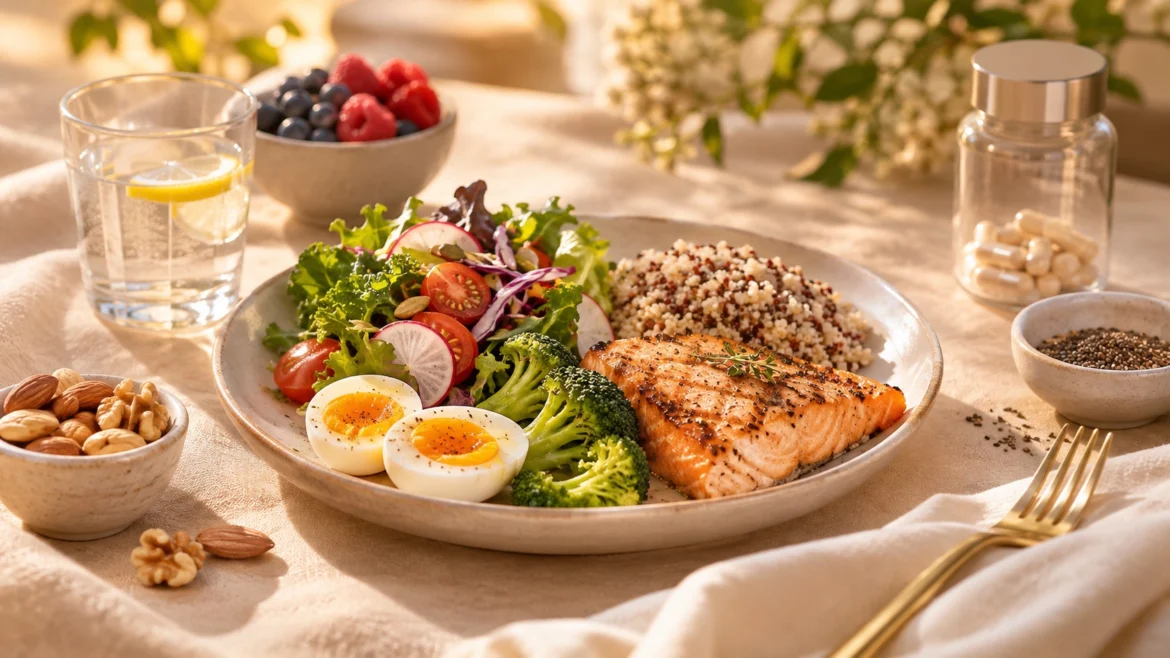
A weight-loss eating plan can include familiar rice, noodles and dishes. A meat-heavy lunch box with few vegetables could gain a side of greens, retain an appropriate staple and protein food, and have sauce served separately. Both balance and total portion matter; a particular “diet food” cannot guarantee weight loss.
How to divide a main meal
Hong Kong’s Centre for Health Protection illustrates a lunch box with grains, vegetables and meat or alternatives in a 3:2:1 ratio by volume. Imagine six equal spaces. Rice, noodles or another grain take three spaces, vegetables two, and fish, meat, eggs or an alternative one. Use the picture as a way to notice what you have on the plate. A large box divided this way still contains more food than a small box filled in the same proportions. The ratio also cannot tell you the meal’s calorie content. Centre for Health Protection lunch box illustration
- Rice, noodles or another staple. Ordinary rice can be part of the meal. Check how much is in the box and whether it comes with vegetables and a protein food. If you want to try brown rice and find the texture unfamiliar, you could cook it with white rice.
- Vegetables. Choy sum, cabbage, green beans and broccoli can make up a side that is large enough to notice on the plate. If you are deciding between plain blanched greens and aubergine in a heavy sauce, the greens give you more control over how much sauce to add.
- Protein foods. Fish, chicken without skin, eggs and tofu are common choices. You can swap fish for tofu depending on what you can buy, cook and enjoy. Equal-looking pieces of fish and tofu need not supply the same amount of protein. High-protein foods and meal combinations
Dishes often combine several foods. Tomato and egg stir-fry can contribute both tomatoes and eggs, although a serving may contain only a few slices of tomato. If that is the case, look for another vegetable dish. A plate of rice topped with a spoonful of corn and diced meat looks different from a rice meal that includes a full side of greens. Look at the amounts that are actually served before deciding what the meal could use.
At home, a stew can also be hard to judge while it is still in the pot. Put the usual amount on a plate and see how much goes to each part of the meal. If most of the vegetables cooked down or the remaining servings contain mostly sauce, adding a side may be easier than making a second stew.
What can you order at a canteen or café?
Choose an adjustment the kitchen can make. It may be difficult for a busy café to change how a dish is cooked, but it might be able to serve sauce on the side, offer an unsweetened drink or add a vegetable dish. Some kitchens let you order a different side with an existing set meal. These examples show where to check. Actual ingredients and portions depend on the outlet. Centre for Health Protection dietary guidance
| Usual order | An option to compare | What to check |
|---|---|---|
| Rice with one or two toppings | Keep the rice and choose vegetables alongside fish, meat, egg or tofu | Can sauce come separately and are the vegetables a full side or a small garnish? |
| Noodles in broth | Consider an order with egg, sliced meat or tofu and add greens if needed | If you want to reduce sodium, you can leave some of the broth |
| Baked rice or pasta | Add a salad or vegetables if the dish has very little, and use separately served dressing as needed | The name does not show how much cheese, cream or sauce is in it |
| Rice ball or sandwich | Check for a filling such as egg or tuna and add a side if the meal is small | Look at the filling and the number of pieces or servings in the package |
If the portion is more than you want, choose a smaller size where available or set some aside in a clean container before eating. Make sure you can refrigerate leftovers promptly and follow food safety guidance. If there is no fridge at work, finding a portion that suits you at the time of purchase may be more practical. When your usual meal already has a good combination of rice, vegetables and protein food, choosing an unsweetened drink can be the easier change.
When sharing dishes with friends, take a portion onto your own plate so you can see the balance of rice, vegetables and protein food. You can dip into a shared sauce rather than pour it over the whole meal. If friends order something fried, look at whether there are steamed fish, tofu or greens as well. A dish can be part of the meal without taking up the whole plate. This way of looking at the meal also gives you more information than simply recording that you ate fried food.
A familiar takeaway can be a useful place to start. If you buy chicken rice three days a week, ask for a side of greens the next time, then see what it costs and whether it is available when you have only a few minutes. Later you could try sauce on the side. Keeping the rest of the order familiar lets you work out which change is worth making regularly. If even the small change consistently makes you late for class, another place with a vegetable side already in the set may work better.
A labelled serving and the amount you eat
A nutrition label uses a serving as the unit for its figures. The amount you eat is the part of the package you actually finish. For example, if a box has two servings and lists 180 calories per serving, the full box contains 360 calories. Half of the contents contain 180 calories in that example. The arithmetic shows how to read the package. It does not give you a target for lunch. NIDDK guide to portions and label servings
Two labels might use different units. One list may show the amount per 100 grams while the other shows it per piece. Find the weight of a piece before comparing like with like. If you want to know what is in one piece you plan to eat, calculate the amount for that piece. A separate sauce packet may also list more than one serving. If it contains two servings and you use half of it, the amount you use equals one of those servings.
A two-serving package can be convenient when you have somewhere to store the second part. If you usually buy it on the way to class, have no storage and end up eating the whole package, the relevant number for that meal is the amount in the package. Reading both the serving size and the serving count before you buy lets you factor that into the choice.
Hungry again soon: what might be missing?
- Only a roll or rice ball: add an egg, plain yoghurt or another accessible protein food and include vegetables with main meals.
- A balanced lunch but six hours until dinner: plan a safely stored snack or an earlier dinner rather than always enlarging lunch.
- Regularly uncomfortably full: order a smaller size, share, or set aside a portion where safe refrigeration is available.
If tracking weight, review several weeks of trends and what was manageable. A hungry afternoon alone cannot judge the whole plan.
Compare a common unit and the amount actually eaten
Figures per 100 g compare equal weights. Figures per piece or package may better describe finishing the item you buy. Suppose hypothetical food A contains 200 calories per 100 g and comes in a 150 g pack: the whole pack contains 300 calories. Food B has 250 calories in a 100 g pack. A is lower at equal weight but higher when each entire pack is finished. These are illustrative calculations, not retail products or a lunch calorie target. (Source)
The method also applies to sodium, sugar or protein while retaining the units. Sodium is commonly declared in milligrams; it cannot be treated as the same numerical amount of salt in grams. Without a specific clinical restriction, comparisons among similar foods bought regularly are usually more practical than changing the entire meal over a tiny numerical difference. The calculation should clarify the choice rather than turn every purchase into a requirement for perfect arithmetic.
No added sugar does not describe the complete meal
No added sugar concerns addition; it does not establish the absence of naturally occurring sugar or zero energy. Compare the sugar, protein and actual portion on a yoghurt or drink panel. Added honey, syrup or cereal belongs to the final combination, so the plain base alone no longer describes everything eaten. The ingredient list and nutrition panel answer related but different questions.
A lower-salt description also does not make the quantity of sauce irrelevant. A small declared serving can look low while several servings are used. When eating out without a full label, workable actions such as separately served sauce, leaving broth or choosing a plainer side are available without inventing exact figures for a cooked dish. Be clear about what is known and what is being estimated; the meal does not need a fabricated number to be discussed sensibly.
A microwave does not replace cold storage before lunch
A meal cannot be left in a handbag all morning simply because a microwave is available later. CFS advises prompt cooling and refrigeration at 4°C or below within two hours. Set aside the next meal’s portion into a clean shallow container before dining to reduce repeated handling at the table. Refrigerate it on arrival at work where facilities are available, rather than wait until lunchtime to think about storage.
Time between 4°C and 60°C matters: food held for less than two hours can be refrigerated for later use; at two to four hours it should be eaten immediately rather than returned for another meal; beyond four hours it should be discarded. This is a rule for handling food that has left safe temperatures, not encouragement to plan several hours at room temperature. Keep the relevant time in view across the journey and storage period.
Reheat thoroughly; CFS specifies a core temperature of at least 75°C. Stir partway through microwave heating to reduce cold spots, and do not repeatedly reheat the same meal. Where proper cold or hot holding and reheating are unavailable, buying at mealtime or using food suitable for room-temperature storage according to its package may be more workable than forcing a chilled packed-meal plan into unsuitable facilities.
Use familiar staples without cooking a new complete menu every night
Start with the staple already at home, then choose a protein food and vegetables you will actually use. Rice, tofu and frozen vegetables provide one familiar combination; noodles, egg and cabbage provide another. They do not automatically contain the same nutrients. Ingredients and portions still matter, and a convenient combination is not a promise of a particular weight outcome.
Before buying, check how many evenings are spent at home and which days allow safe refrigeration for a packed meal. A cheap large pack that is half discarded may cost more per meal used than a smaller pack. Include oil, sauces, sides and drinks when comparing spending instead of pricing only the staple. The relevant budget is the meal that will actually be bought, prepared and eaten.
A household can share dishes while serving rice and sauce separately to accommodate appetites and needs. Allergies, kidney disease and other prescribed restrictions require checking ingredients and preparation; separate plates alone do not resolve them. A workable routine should fit the existing care plan rather than replace it with a generic ratio. Keep those restrictions visible when making substitutions so convenience does not quietly change an agreed requirement.
A microwave and a limited budget
With rice or noodles already at home, eggs, tofu, cabbage and frozen vegetables can fill the other parts of the meal. Frozen vegetables may be plain or seasoned. Serve rice and dishes separately so household members can adjust portions and sauce.
Refrigerate and reheat packed meals safely. If food cannot stay cold, buying at mealtime is more appropriate than leaving perishable food until the afternoon. Compare takeaway spending including the sides, drinks and snacks you would actually buy.
Diabetes, kidney disease, eating difficulties or an individual diet plan require the existing care team’s guidance. A general lunch-box ratio cannot set personal portions or nutrient restrictions.