
Start with the instructions for your own iron product or prescription. Some oral iron preparations are better absorbed on an empty stomach, but taking them that way can be hard on the stomach. Tea, coffee, dairy and certain medicines may also affect the schedule. Put your meals, drinks and medicines on the same list before choosing a time.
Nutrition intake and treatment are different starting points
Iron in food contributes to everyday nutrition. Oral iron prescribed for diagnosed iron-deficiency anemia is part of a treatment plan. A daily dietary reference and a treatment regimen answer different questions; a retail serving is not automatically the amount a person needs to correct a deficiency. Choosing an hour comes after establishing why the iron is being taken.
Iron stores can fall before anemia develops. Feeling tired, looking pale or noticing a change in nails cannot determine whether to start a supplement. Clinicians may assess blood counts, hemoglobin and ferritin together. Ferritin can also be affected by inflammation, so an isolated result is not a reliable instruction to raise a dose independently.
Where ongoing blood loss, an absorption problem or another illness contributes to deficiency, moving the tablet to an empty stomach cannot address the underlying cause. Pregnancy and existing medical treatment can also change the plan. The aim is to fit a confirmed regimen into the day, rather than use a convenient schedule as the reason to begin iron.
For the assessment context, see guide to iron deficiency symptoms and blood tests.
Why ferrous sulfate can have two sets of meal instructions
For ferrous sulfate, the NHS advises taking it 30 minutes before eating or two hours afterward if you can tolerate it. If the medicine upsets your stomach, the guidance also allows taking it with food or after a meal. This is an example for ferrous sulfate. The instructions for other forms or products can differ, so use the pharmacy label or advice you were given.
If you usually drink coffee or milk tea with breakfast, include it when you review your schedule. NHS ferrous sulfate guidance advises leaving a two-hour gap for tea, coffee, dairy and eggs, which can reduce iron absorption. A pharmacist can check how that guidance fits your specific product and other medicines. Keep following the directions for prescribed medicines while you ask about the schedule.
An empty stomach and a drink interval are separate instructions
“Thirty minutes before food” and “leave two hours from certain drinks or foods” are not interchangeable rules. The first describes the relationship to a meal in the ferrous-sulfate example. The second concerns particular items that can reduce absorption. Waiting thirty minutes does not automatically make every breakfast drink compatible with the remaining instructions.
For example, an adult whose clinician has agreed to ferrous sulfate before breakfast still needs to consider tea, coffee, dairy and eggs when arranging that meal. If these are fixed parts of breakfast, ask a pharmacist about another permitted time. There is no need to remove entire nutritious food groups from the long-term diet simply to fit one dose into an inconvenient slot.
Conversely, a product that explicitly recommends use with a meal should not be moved to an empty stomach just because another iron preparation has different directions. A theoretically convenient absorption window is not useful if nausea repeatedly prevents the regimen being taken. Tolerance, actual use and blood-test response all matter to the clinician’s decision.
These examples explain how to read instructions; they do not supply a timetable for someone taking additional prescription medicines. For a particular regimen, the medicine schedule may determine which meal window is available.
When to ask about taking iron on alternate days
Clinical guidance for iron deficiency anemia notes that alternate-day dosing may be better tolerated by some patients. Ask the clinician who prescribed your iron whether it is appropriate for you. Do not change your prescribed frequency or take extra at the next dose on your own. If you have nausea, constipation or discomfort, record how much you took, whether you had eaten, and when the symptom appeared. Bring those notes and the package to the pharmacy or your next appointment.
Check iron against the medicine you already take
Iron can reduce the absorption of levothyroxine. The NIH Office of Dietary Supplements notes that some levothyroxine labels tell patients to keep iron supplements at least four hours apart. Ask the pharmacist to check the exact formulation and directions on your prescription. Also bring any antacids, calcium supplements and other medicines you use. They can have requirements of their own, and a schedule that works for breakfast and coffee may still clash with a medicine.
Write the regular medicines on the schedule first. Then add meals, drinks and the iron instructions. If two instructions appear to conflict, show both labels to the pharmacist. Ask which item needs to come first and what to do if your meals shift on a workday. Keep following the prescribed medicine’s directions while you ask about the timing.
See NHS ferrous sulfate guidance for meals and missed doses, AGA expert guidance for clinician-selected alternate-day use, and NIH ODS for levothyroxine examples. A pharmacist should check the actual medicine.
There is no single spacing number for every medicine
The NHS lists several medicine groups that warrant review with ferrous sulfate, including some antibiotics, indigestion remedies and products containing other minerals. An interval that applies to one medicine should not be transferred to another. “Keep everything two hours apart” is not a replacement for checking the exact prescriptions, particularly where a label gives a different interval.
| Item to bring into the review | Why it matters |
|---|---|
| Levothyroxine | Some labels require at least four hours from iron; formulation and prescription directions matter |
| Certain antibiotics, including doxycycline or ciprofloxacin | The actual drug and its dosing directions determine the arrangement |
| Antacids, indigestion products and mineral supplements | Nonprescription products can also contain relevant ingredients |
| A second iron-containing multivitamin | Total iron needs review as well as the clock time |
Use the complete name, dosage form, amount and existing directions when asking the pharmacist. A label photograph is more specific than describing something only as a stomach medicine. An existing medicine may also have its own food requirement. Ask for a workable combined schedule without independently stopping it, changing its frequency or treating the supplement as the priority.
Is separate vitamin C essential?
Recommendations differ. AGA expert advice recommends adding vitamin C. A 2020 randomized trial in 440 adults with iron-deficiency anemia found comparable hemoglobin improvement with and without added vitamin C, meeting its equivalence criterion. Most participants were women; the result does not replace every individual’s prescription. Trial
Do not buy another supplement solely because vitamin C is presented as mandatory. Ask before changing an existing prescribed regimen.
Compound weight is not the same as elemental iron
Elemental iron is the amount to use when comparing the iron supplied. In the examples below, Solgar lists 25 mg iron per capsule and NOW lists 18 mg per 10 mL. Those are not the total weights of a capsule or a liquid serving, and they do not tell you how many milligrams will actually be absorbed by a particular person.
A medicine box may emphasize a weight of the iron compound, such as ferrous sulfate. That number cannot be compared directly with the iron amount in a supplement’s nutrition panel. Find the corresponding elemental-iron information or ask a pharmacist. A conversion remembered from another salt or formulation is not a safe way to choose a replacement.
Package quantity is another separate number. A bottle with 180 capsules or 250 tablets does not determine the required duration of treatment. Nor should a person add a larger serving to compensate for taking one dose with food. The prescribed amount, formulation and response guide the regimen; bottle size and an imagined absorption percentage do not.
For dietary intake rather than treatment amounts, see How Much Iron Do Adults Need? Intake by Life Stage.
Three supplements: meals and dosage forms
Liquid avoids tablets but requires measuring and refrigeration. Capsules offer a portable single-unit format. These are manufacturer directions, not permission to replace prescribed treatment.
This article contains affiliate links. ToBeHealthy may earn a commission from purchases through them. Comparisons are based on product information and research, without hands-on testing.
| Product | Label per serving | Formula features and practical considerations |
|---|---|---|
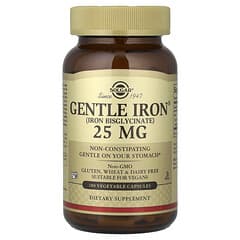 Solgar Gentle Iron, 180 vegetable capsules | 25 mg per capsule, preferably with a meal | 25 mg bisglycinate iron alone; vegan capsule; preferably with a meal. |
 NOW Foods Liquid Iron, 237 mL | 18 mg per 10 mL, empty stomach per label | Liquid ferric glycinate; 18 mg per 10 mL; xylitol-sweetened; refrigerate after opening. |
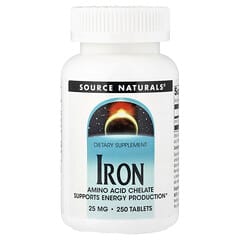 Source Naturals Iron, 250 tablets | 25 mg per tablet, no meal specified | Amino-acid-chelated iron tablet; 25 mg each; contains soy and sorbitol. |
Solgar Gentle Iron, 180 vegetable capsules
Solgar Gentle Iron uses ferrous bisglycinate chelate, supplying 25 mg iron per capsule. The 180-count bottle has once-daily label directions; treatment duration is set separately with the healthcare team. It is suitable for vegans, carries gluten-free and kosher labeling, and has no dairy, soy, sugar or artificial sweeteners.
The brand positions it around gastrointestinal tolerance, although individuals can still experience discomfort. Adult directions are preferably with a meal, unlike the empty-stomach directions of the liquid below. Iron supplementation should follow test results and healthcare advice, and all iron products must be kept out of children’s reach.
View Solgar Gentle Iron, 180 vegetable capsules details and price
NOW Foods Liquid Iron, 237 mL
NOW Foods Liquid Iron supplies 18 mg elemental iron per 10 mL as ferric glycinate, without swallowing a tablet or capsule. Natural fruit-punch flavor, xylitol and stevia provide the taste. Each serving contains 1 g xylitol, a relevant ingredient when comparing liquid formulas.
- The 237 mL bottle provides about 24 servings.
- Shake before use and follow the label’s empty-stomach directions with water or juice.
- Refrigeration is required after opening, making it most practical where you can measure and store it at home.
- Equal liquid volumes from different products need not contain equal iron.
- Keep it out of children’s reach.
View NOW Foods Liquid Iron, 237 mL details and price
Source Naturals Iron, 250 tablets
Source Naturals Iron tablets bind iron to amino acids from hydrolyzed vegetable protein, providing 25 mg iron per tablet. The 250-tablet bottle offers a tablet format for an established, healthcare-guided routine, without added vitamins C or D or artificial colors and flavors.
The ingredients include soy and sorbitol, which matter for soy allergy or a preference to avoid sugar alcohols. Directions are one tablet daily without a specified meal requirement. Check medicine spacing for the actual drug with a pharmacist, and store all iron products out of children’s reach.
View Source Naturals Iron, 250 tablets details and price
Daily use differs between liquid, capsules and tablets
Liquid can be practical when swallowing solid doses is difficult, but concentration, measuring equipment and storage still need attention. An ordinary kitchen teaspoon is not a calibrated medicine measure. Two bottles described as liquid iron can supply different amounts in the same volume, and a prescribed drop preparation is not interchangeable with an adult dietary supplement simply because both are liquids.
Liquid iron may stain teeth. NHS information for ferrous-sulfate drops advises rinsing with water afterward. Whether a particular product can be mixed into a drink, and which drink or measure to use, remains product-specific. The NOW formula below permits water or juice; that statement should not be extended to every liquid or used as permission to mix iron into a dairy drink.
Keep the actual directions when considering a different format. Do not suck a tablet, treat it as a chewable sweet or independently crush it to avoid swallowing. A pharmacist can check whether another suitable dosage form is available. Difficulty swallowing is a practical reason to review the product, not a reason to improvise a way of taking a medicine.
Storage also affects which option fits a routine. NOW requires refrigeration after opening, whereas Solgar lists room-temperature storage. Keep an identifiable package and the directions when traveling. If suitable storage is unavailable, discuss a workable formulation rather than leaving a refrigerated product indefinitely in a bag or vehicle. The product chosen should be usable as directed in the place where it will actually be taken.
Side effects and missed doses
- Ferrous sulfate can cause constipation, nausea, stomach pain or diarrhea. Discuss food, frequency or formulation rather than tolerating severe symptoms or abandoning treatment; directions differ between products.
- NHS ferrous sulfate guidance advises skipping a missed dose if the next is near, without doubling. Follow the instructions for a different prescription.
- Use the specified measure for prescribed liquids, not a kitchen teaspoon. Equal volumes of different concentrations are not interchangeable.
- Darker stools can be an iron effect, but tarry stools, blood or feeling unwell still warrants care.
Keep iron in its original container out of children’s reach. Suspected overdose needs immediate medical help without waiting for symptoms. Symptom improvement does not establish restored stores; continue the agreed monitoring before changing treatment.
Monitoring involves more than whether energy improves
Hemoglobin and ferritin provide different information. Hemoglobin relates to oxygen-carrying red cells; ferritin is commonly used to assess stored iron, with interpretation affected by factors such as inflammation. These measurements need not change together. Better energy does not establish that stores have been replenished, while continuing fatigue alone does not prove that the chosen hour is ineffective.
At follow-up, bring the actual product and describe whether nausea or other difficulties have prevented doses being taken. Mention newly added indigestion medicines or supplements, as well as ongoing bleeding or other symptoms. This helps the clinician distinguish a practical administration problem from a need to investigate the cause or reconsider treatment. Repeatedly moving the same dose between morning and evening may leave the relevant problem untouched.
At the start, ask what will be checked, when review is due and which symptoms need an earlier call. Avoid choosing a stopping point from a ferritin target found online, a fixed number of months or the number of tablets left. An agreed monitoring plan is more informative than finishing a large bottle. Persistent intolerance needs an alternative plan with the healthcare team, rather than repeated missed doses followed by extra tablets.
Two remaining timing questions
Can iron be taken at bedtime?
Evening use is not universally ruled out, but it must fit the actual product’s food directions and any medicine intervals. Ask a pharmacist to confirm that arrangement when other treatment is involved. The available guidance does not establish one best clock time for every iron preparation or every person.
Does calcium-fortified plant milk count in the review?
Check whether calcium has been added rather than assuming a drink is irrelevant because it is not dairy milk. Show the label alongside any calcium supplement when asking about timing. This is a question about the administration window, not a reason to avoid dairy, plant drinks or other calcium sources throughout the diet.