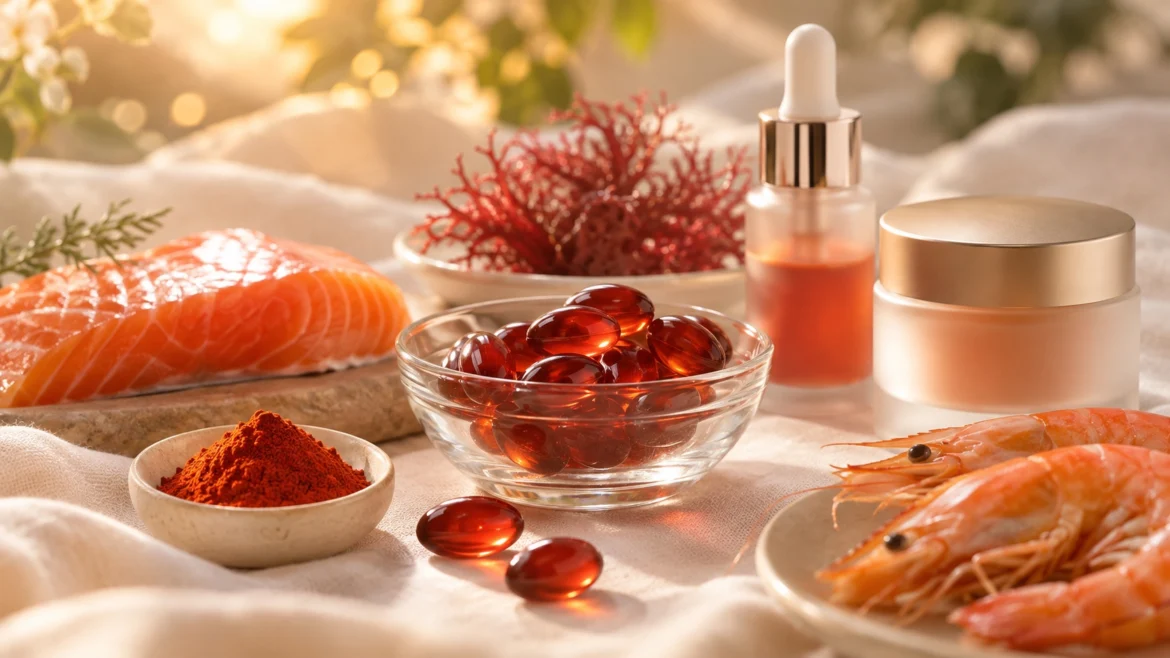
Studies of oral astaxanthin have reported improvements in skin hydration and elasticity measurements. They have not shown a clear reduction in wrinkle depth. For eyes, one screen-task study found a difference in a particular vision test within an age subgroup. That result does not tell you whether a supplement will relieve the gritty feeling you get after working at a computer. Start by checking whether the study measured the change you care about.
What is astaxanthin?
Astaxanthin is a carotenoid pigment found in some algae and seafood. A common source for supplements is the microalga Haematococcus pluvialis. Look for the amount of astaxanthin itself in a supplement facts panel, especially when the front of the package gives a weight for the whole algae extract. If the formula includes lutein or zeaxanthin, read each amount separately. A single figure for the blend cannot tell you what you would take of each pigment.
The term “antioxidant” can describe something observed under particular experimental conditions. It gives you little information about how you might feel after taking a capsule. To evaluate a claim about dry skin, for example, look for a study in people that measured skin hydration or asked about dryness. A laboratory measurement of antioxidant activity can be interesting, but it answers a different question from whether a dry patch becomes less bothersome.
Can it help skin hydration, elasticity or wrinkles?
A systematic review pooled trials of oral astaxanthin. Compared with placebo, the combined results showed improvements in measures of skin moisture and elasticity. The difference in wrinkle depth was not statistically significant. The elasticity results varied considerably from one study to another. That variation limits what you can predict from the pooled result about using a particular product. Systematic review of astaxanthin and skin ageing
| Outcome | What the measurement can tell you |
|---|---|
| Skin hydration | An estimate of how much water the skin holds where it was tested. |
| Skin elasticity | How the skin responds to a specified test, such as how it returns after being gently pulled. |
| Wrinkle depth | How deep a wrinkle is in the area measured. The pooled difference was not statistically significant. |
A hydration reading and the feeling of tightness after washing are different outcomes. Similarly, a measure of elasticity does not show whether you will see fewer lines in the mirror. If your main concern is an area that flakes or feels tight, look for measurements at a relevant site and reports from participants about how their skin felt. A result from an instrument is useful even if the trial did not establish a visible difference, provided it is described as the result the instrument measured.
Researchers sometimes report a standardised difference so that results from different scales can be combined. It is tempting to read a value on that scale as a percentage improvement. The number is not a percentage. It cannot tell you that skin became a certain percentage more hydrated or that there was the same change in every trial. It is more useful to note which outcome was measured and how much the studies agreed.
If a product advertises a result after several weeks, look for the visits in the trial. The week when the measurements were taken is not necessarily when the change began. A trial may have checked at the start and at the end, leaving the time in between unmeasured. Also check whether the researchers were testing a supplement taken by mouth or a product applied to the skin. The route matters when you compare it with what you can buy.
What did researchers find after screen work?
A six-week trial analysed data for 59 people who completed a screen task. In the subgroup aged 40 or older, there was a difference between the astaxanthin and placebo groups in one measurement of corrected visual acuity of the dominant eye after the task. Many other acuity measurements did not show a clear difference. The participants under 40 did not show significant differences between groups in the near-point acuity measures. Randomised trial of visual function after screen work
The study did not establish that everybody who spends time at a computer will feel more comfortable after taking astaxanthin. The subgroup that showed a difference was smaller than the full set of participants. A change on one corrected vision test after a specified task does not describe how your eyes will feel at five in the afternoon. You can use the study to see what has been tested and where a larger or more directly relevant trial is needed.
If your eyes regularly feel gritty, dry or irritated after screen use, note when the symptoms start and whether you are wearing contact lenses or sitting in moving air. Those details can help you decide what to address first. New changes in vision need an assessment rather than a supplement trial at home. See dry eyes, screens and when to seek care for signs to watch for and practical steps.
How to interpret a trial that tested a blend
An eight-week trial compared a softgel containing astaxanthin, lutein and zeaxanthin with a placebo. The researchers reported better performance in an eye–hand coordination test after screen work in the group taking the blend. They did not find a clear improvement in smooth pursuit eye movements. The trial had no separate astaxanthin-only group, so it could not isolate the contribution of astaxanthin to the coordination result. Randomised trial of the three-carotenoid blend
This detail matters when shopping. A label can list one of the ingredients used in a study and still be a different product. If the study tested three ingredients together, compare the complete formula and the amounts before relying on its results. A person buying a single-ingredient capsule cannot expect it to reproduce the results of the whole blend. Likewise, a study of how people perform on a coordination task does not establish a benefit for dry eyes or any particular eye disease.
What does the safety assessment say about 8 mg?
The European Food Safety Authority assessed astaxanthin from a specified algae source in supplements, taking dietary intake into account. Under the conditions assessed, 8 mg a day from these supplements in addition to dietary sources was considered safe for adults. This is an assessment of safety for a defined source and group. It does not give a recommended daily intake for everyone or identify an amount that works for skin or eye symptoms. Do not apply the adult assessment directly to children or adolescents. EFSA safety assessment of astaxanthin
Read the serving size before you compare two packages. If one lists 8 mg per two capsules and another lists 8 mg per capsule, the labelled servings contain the same amount but use different numbers of capsules. Also check the suggested frequency. If you already take a blend containing astaxanthin, use the amount you actually take from each product to see where the ingredient is repeated. This is a check of your total, rather than a reason to aim for the level in the safety assessment.
The source of the astaxanthin tells you only part of what is in a capsule. An algae-derived ingredient can be sold with a carrier oil, an animal gelatin shell or other ingredients in the same blend. If you need to avoid seafood ingredients or any allergen, look at the complete ingredients and allergen statement on that exact package. Ask a healthcare professional before adding a supplement if you are pregnant, breastfeeding or taking medication. If a supplement causes discomfort, stop using it and seek advice as appropriate.
Separate the weight of an extract from the pigment
Consider a bottle that lists a weight for the whole algae extract and then gives the amount of astaxanthin it supplies. The second figure is the one to use when comparing the pigment. Do not add it to the extract total, because it forms part of that total. If another product lists only the extract weight, record that the pigment amount is missing. You cannot compare its astaxanthin content directly with a label that declares the pigment separately.
Also look at where the nutrition panel gets its serving number. A product can put “60 softgels” prominently on the front, while the facts panel gives amounts for two softgels. In that case, you have 30 labelled servings. This kind of label check can help you distinguish how big the container is from what you would take each time. It does not tell you whether you need any supplement.
What decisions can the findings support?
- Visible wrinkle reduction: the pooled wrinkle-depth result was not significant. Hydration and elasticity cannot substitute for wrinkle evidence.
- Screen-related dry eyes: the visual-acuity and coordination trials do not directly establish relief of everyday dryness. Airflow, lenses and ocular-surface assessment fit that concern more closely.
- Single ingredient versus an eye blend: a combination trial concerns that tested combination, without allocating the effect to each ingredient. Avoid purposeless overlap with existing lutein products.
The skin review included nine oral randomized controlled studies and two open-label studies. These designs are not equivalent, and elasticity findings varied considerably. The evidence cannot promise noticeable improvement or a fixed onset date for everyone.
With existing fish-oil, eye or beauty blends, check repeated astaxanthin and other ingredients before buying. Pregnancy, breastfeeding, medicines or persistent symptoms call for individual assessment rather than direct use of short-term healthy-adult findings.
Nine oral studies do not become eleven oral trials
The skin review’s nine controlled studies assessed oral astaxanthin; its two open-label studies involved topical or combined oral-topical use. Applying a product to skin differs from swallowing a capsule. Combining both routes also makes their individual contributions difficult to separate. The eleven studies should not be advertised as eleven trials proving oral efficacy.
Open-label observations lack the same blinding and placebo conditions: participants and researchers know what is used, with other possible influences. That does not make every observation worthless, but it does prevent treating it as equivalent to randomized controlled evidence.
An abstract’s conclusion may be broad. A purchasing decision needs the actual oral outcomes: more favorable moisture and elasticity estimates, without a significant wrinkle-depth difference. General anti-aging language cannot turn every measured outcome into an improvement. The route, comparison and outcome need to remain attached to the finding when it is summarized.
Why the older subgroup does not represent every screen user
The six-week visual study did not find a clear group difference across the full participant analysis. More favorable findings came from the subgroup aged 40 or older and particular visual measurements. The authors also stated that the significance level was not adjusted for multiple items and repeated sampling. Testing many outcomes makes a small selection of favorable findings less secure as a general promise.
The trial excluded people with frequent eye fatigue who regularly performed screen work, alongside several eye conditions, eye medications and other health circumstances. Someone with daily stinging or discomfort in lenses cannot assume an identical population merely because a computer is involved.
This is a lead for further research, not an assurance of greater comfort for students, regular lens wearers or people with diagnosed dry eye. Beyond asking whether a study exists, ask whether it examined the same symptoms in comparable people. A well-described task in a laboratory can still leave the everyday question unanswered.
Keep a trial amount separate from a safety assessment
The six-week trial used 9 mg daily, whereas the EFSA assessment discussed above concerns 8 mg from supplements together with dietary intake. They answer different questions. A limited number of participants observed for weeks does not automatically extend a safety assessment to higher long-term intake for everyone.
Amounts from separate products also need adding. In a hypothetical example, 4 mg from a standalone product and 6 mg from an eye blend total 10 mg on the same day. Each product being below a number does not keep their sum below it. This illustrates accounting, not a recommended amount. Missing pigment information should be clarified rather than calculated from algae-extract mass alone.
For dryness or lines, define the desired outcome before spending. An instrument’s hydration reading, a photograph and personal comfort answer different questions. Changing skincare or sun exposure at the same time also prevents a before-and-after observation from isolating a supplement’s effect. New visual symptoms need assessment rather than waiting through a research-length trial of a supplement. The decision should follow the actual concern, not the broadest benefit printed on a mixed formula.