
For a fish oil label that lists 320 mg EPA and 200 mg DHA per two softgels, the combined amount is 520 mg per serving, or 260 mg per softgel. Apply the same calculation to each bottle, then compare costs per 100 mg of EPA plus DHA.
Find the Four Figures on the Label
| Label entry | What it measures | How to use it |
|---|---|---|
| Serving Size | The number of capsules or the volume in one serving | Divide the per-serving amount by the capsules or mL |
| Fish Oil | The amount of fish oil in one serving | Compare by weight if the EPA and DHA amounts refer to the same serving |
| Total Omega-3 | All the omega-3 fatty acids included in that total | Use it to compare total omega-3. The total may include other fatty acids |
| EPA and DHA | The amounts of these two fatty acids, separately or as a combined figure | Add the separate values or use the stated combined amount |
A bottle that says “1,000 mg Fish Oil” gives you the weight of the oil. Read the Supplement Facts panel to see how much EPA and DHA it contains. If the label gives only a total omega-3 amount, you need additional information to work out EPA and DHA. A combined EPA and DHA line can be used directly when that is all you want to compare.
Two Examples: Softgels and Liquid
These labels are hypothetical. First put all the fatty-acid amounts into milligrams. One gram is 1,000 mg.
| Step | Softgels | Liquid |
|---|---|---|
| Serving size | 2 softgels | 5 mL |
| EPA and DHA listed per serving | EPA 420 mg and DHA 280 mg | EPA 540 mg and DHA 360 mg |
| Add EPA and DHA | 420 + 280 = 700 mg per serving | 540 + 360 = 900 mg per serving |
| Divide to find a smaller unit | 700 ÷ 2 = 350 mg per softgel | 900 ÷ 5 = 180 mg per mL |
| Bottle size | 60 softgels | 150 mL |
| Servings in the bottle | 60 ÷ 2 = 30 | 150 ÷ 5 = 30 |
If the liquid label uses a teaspoon or a dropper and also lists its serving volume in mL, use the stated volume. A number in mg per mL describes the amount in a volume. To calculate a percentage by weight, you also need the weight of the oil in that volume.
Calculate the Ratio, the Percentage, or the Price
EPA to DHA ratio.
The softgel example has 420 mg EPA and 280 mg DHA per serving. That is 420 to 280, or 3 to 2. To compare how much you get per serving, use the combined amount of 700 mg.
EPA and DHA percentage by weight.
Suppose the softgel label also states 2,000 mg of fish oil per serving. Divide the combined EPA and DHA (700 mg) by the fish oil (2,000 mg), then multiply by 100. That gives 35% EPA and DHA by weight. A label may use total omega-3 to report a different percentage. Check which fatty acids went into the calculation before comparing percentages.
Cost per 100 mg of EPA and DHA.
Multiply the amount per serving by servings per bottle. Then divide the price by the bottle’s total milligrams and multiply by 100. The example prices below are in US dollars.
| Cost calculation | Softgels at $21.00 | Liquid at $24.30 |
|---|---|---|
| EPA and DHA per bottle | 700 × 30 = 21,000 mg | 900 × 30 = 27,000 mg |
| Price per 100 mg | $21.00 ÷ 21,000 × 100 = $0.10 | $24.30 ÷ 27,000 × 100 = $0.09 |
The liquid costs more per bottle in this example and less per 100 mg. If you want to compare what you would pay, calculate the price on the same basis for both products, including shipping or discounts where applicable.
Start With the Numbers on the Back of the Same Bottle
Write down the product name, bottle count or total volume, and serving size before copying the amounts. This avoids a common shopping error. A listing might show a front image for the smaller bottle and a facts panel for a larger or differently concentrated version. Check that the same capsule count, flavor, and formula appear in both places. Versions with added vitamin D may look nearly identical to plain fish oil. The serving size can differ between variants that share a brand name. Review the specific bottle shown in your cart before entering its price in your notes.
Next, keep fish oil, total omega-3, EPA, and DHA in separate columns. Leave a cell empty when the amount is unavailable. An empty cell means you need more information about that ingredient. Entering zero would imply that the label declared no EPA or DHA. If the panel states “EPA and DHA combined,” enter that amount once and leave the individual cells empty. The combined number works for price comparisons, while the individual ratio remains unknown.
Sometimes the front-panel quantity is per capsule and the back gives a number per two capsules. Both can be correct. Multiply the per-capsule figure by the serving size and compare it to the same ingredient on the back. If the figures still disagree, check whether the wording changed from fish oil to omega-3 or from omega-3 to EPA and DHA. If the product, ingredient and serving basis all match, ask the manufacturer which label applies to the bottle you are considering.
Match the Calculation to the Shopping Question
Use milligrams per softgel when you want to compare two capsule formulas on the same basis. Use milligrams per milliliter when comparing liquid bottles. For a liquid and a softgel, pick a common measure such as cost per 100 mg of combined EPA and DHA. Then separately record how many capsules or what volume the amount represents. A softgel is a package unit, so the contents of one softgel across two bottles can differ substantially in weight.
Keep EPA and DHA in two columns when you care about the split. For example, 500 mg EPA plus 200 mg DHA has the same combined amount as 350 mg EPA plus 350 mg DHA. The first is 5:2 and the second is 1:1. The combined amount tells you what the two provide together. The ratio describes the relationship between their quantities. For background on those quantities, see the guide to EPA and DHA. A fish oil and algae oil comparison covers a separate decision about the source.
A lower unit price can come with a larger bottle and higher upfront cost. If you travel often, compare what fits in your bag and how you expect to store it. For a liquid, read the storage directions, including any instructions after opening. A lower unit price is of limited value if some of the contents will go unused. Keep practical concerns in a separate column while comparing the cost calculated for the labeled bottle.
Three Checks That Prevent Misleading Price Comparisons
Check whether the price buys one bottle or several.
Suppose one 60-softgel bottle costs $24 and two identical bottles cost $42. If each bottle contains 21,000 mg combined, the two-pack contains 42,000 mg. The unit costs are about 11.4 and 10 cents per 100 mg. Buying one costs less that day. Buying two costs less per unit, assuming both bottles will be used. If the lower price depends on buying two, keep that condition in the same row as the price.
Use the exact count for partially used packages.
Suppose a bottle has 59 capsules remaining, with two capsules per serving. That makes 29 full servings and one capsule left. When calculating the total milligrams remaining, use the amount per capsule multiplied by 59. When calculating the number of complete labeled servings, use 29. The last capsule still contains the same labeled amount as the others. If you are estimating the remaining volume in a partially used liquid bottle, record it as an estimate.
Distinguish the shelf price from the amount you expect to pay.
Shipping, any applicable taxes and a conditional discount can change the cost. If you buy several products together, one sensible comparison uses list prices and records any shared order charge separately. Another allocates the shared costs with a consistent rule and then compares your projected spending. Applying an entire order-wide charge to one item and none to another produces a misleading result. See how to compare cost per serving if you are also comparing other kinds of products or different bottle sizes.
Three Fish Oil Labels to Practice the Calculation
Two list one softgel per serving and one lists two. Normalize the amounts before entering the price you would actually pay.
| Product | When to compare it |
|---|---|
 California Gold Nutrition Omega 800 (90 softgels) | One softgel per serving, so the label already gives the per-softgel amounts. |
 NOW Foods Ultra Omega-3 (180 softgels) | A one-softgel serving that is easy to compare with Omega 800. |
 NOW Foods Super Omega EPA (240 softgels) | Convert the two-softgel serving before comparing per-capsule amounts. |
California Gold Nutrition Omega 800 (90 softgels)
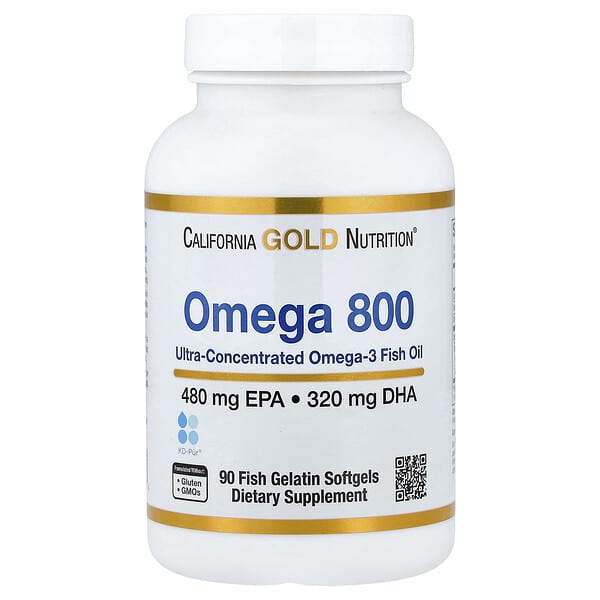
One softgel is one serving. Add the 480 mg of EPA and 320 mg of DHA to get 800 mg per softgel. Use that amount for a combined EPA and DHA comparison; the 1,000 mg figure is the weight of the fish oil concentrate.
- EPA 480 mg and DHA 320 mg per softgel. Total omega-3 is 840 mg.
- KD-Pür triglyceride fish oil with a fish gelatin shell. Declares fish and soy.
- One softgel per serving and 90 servings in this bottle.
View California Gold Nutrition Omega 800 details and price
NOW Foods Ultra Omega-3 (180 softgels)

Ultra also lists a one-softgel serving: 500 mg of EPA plus 250 mg of DHA. Multiply that 750 mg total by 180 softgels to get 135 g of combined EPA and DHA per bottle. Divide your checkout price by 135 to compare the price per gram.
- EPA 500 mg and DHA 250 mg per softgel, from 1,000 mg fish oil.
- Bovine gelatin with enteric coating on this exact version.
- One softgel per serving, for 180 servings.
View NOW Foods Ultra Omega-3 details and price
NOW Foods Super Omega EPA (240 softgels)
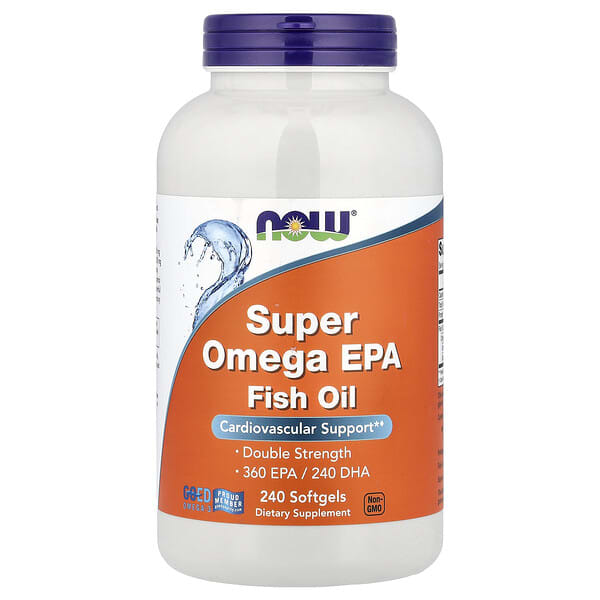
The label reports 720 mg of EPA and 480 mg of DHA for two softgels. That works out to 360 mg of EPA and 240 mg of DHA in one softgel. The 240-count bottle has 120 servings, so its total combined EPA and DHA is 144 g.
- Two softgels provide EPA 720 mg and DHA 480 mg, or 360 and 240 mg per softgel.
- 240 softgels make 120 servings and supply 144 g of EPA and DHA combined per bottle.
- Lists bovine gelatin and fish from anchovies and sardines.
Work Through a Label With an Awkward Serving Size
Imagine two products with servings of three capsules and two capsules. The first lists 540 mg EPA and 360 mg DHA per serving. The second lists 420 mg EPA and 280 mg DHA. The first has 900 mg per serving, the second 700 mg. Divide 900 by 3 and 700 by 2. You get 300 mg and 350 mg per capsule, respectively. The product with more per labeled serving has less per capsule. Keep the serving and capsule amounts visible side by side instead of ranking the products by the larger headline figure.
You can reverse that calculation as a check. If a package lists EPA 180 mg and DHA 120 mg per capsule, a three-capsule serving would supply 540 mg EPA and 360 mg DHA. Either add the two amounts first and multiply by three, or multiply each amount and then add them. Both methods should give 900 mg combined in three capsules. If your two totals disagree, see whether one figure was already listed for the full serving.
Some products report several types of omega-3. For instance, if a serving contains total omega-3 of 1,200 mg with EPA 500 mg and DHA 300 mg, the combined amount is 800 mg. You can calculate a difference of 400 mg between the total and the sum of the two named fatty acids, subject to rounding. That difference does not identify the remaining fatty acids. Use 800 mg for a cost comparison specifically based on EPA and DHA.
Check the Denominator on Any Percentage Claim
Assume one product states 700 mg combined EPA and DHA per 2,000 mg of fish oil. The other states 650 mg combined per 1,000 mg of fish oil. The two percentages are 35% and 65%. The first contains more EPA and DHA in the labeled serving. The second contains more for the same weight of oil. Use the percentage to compare composition. Use milligrams to compare the actual labeled serving or the amount in one capsule.
For a liquid, the mass of oil and the volume you pour are different measurements. If you have the milliliters per serving and the milligrams of EPA and DHA, you can calculate mg/mL. You still need the mass of the oil in that serving to calculate a percentage by weight. Five milliliters of oil should not automatically be entered as five grams. If the maker gives a weight for a different serving volume, check that it refers to the same formula and convert the weight to your comparison basis.
A percent printed on the front might refer to total omega-3, EPA plus DHA, or a specific oil fraction. Look for the quantity it describes before comparing against a different bottle. Writing the units beside each number is a useful safeguard, especially if you revisit an old spreadsheet. A simple table headed “EPA plus DHA per unit,” “% by weight of oil” and “% stated on front” can expose differences that disappear when they all get filed under “strength.”
Keep a Reusable Record for Future Shopping
Save the product version, currency, package size, serving basis, and the EPA and DHA figures shown on the pack. If the package changes, record the new version in a separate row. That preserves which part of the comparison moved. It could be a price increase, a change in bottle size, a change in the label’s serving definition, or a reformulation. Comparing the same size alone will miss many of these changes.
Retain the arithmetic without rounding until the final result. A bottle containing 27,000 mg priced at $24.30 gives $0.09 per 100 mg. If you round the price per milligram to whole cents first, the value appears to be zero. When comparing two currencies, convert the bottle prices using the same basis before dividing. If you are buying both from the same store, using the currency you actually pay is usually enough.
Stop the comparison when it answers the decision in front of you. If the formulas are identical and only the bottle size differs, the per-unit price and expected use may be enough. If you are comparing a liquid and a softgel, keep the cost measure and the physical package amounts. If you are comparing the split between fatty acids, keep both EPA and DHA visible. A compact table focused on one shopping decision is easier to maintain than a broad ranking that hides its assumptions.
EPA and DHA Calculation FAQs
How much EPA and DHA is in 1,000 mg of fish oil?
It depends on the formula. Read the EPA and DHA figures on the label. Confirm whether the amounts refer to one capsule or to a serving with several capsules.
Can I find the EPA-to-DHA ratio from a combined amount?
You can use the combined amount for per-capsule or cost calculations. You need the individual EPA and DHA amounts to find the ratio.
How do I calculate EPA and DHA separately per capsule?
Divide each value by capsules per serving. In the softgel example, divide 420 mg EPA and 280 mg DHA by two. Per softgel, that is 210 mg EPA and 140 mg DHA.
How do I calculate a daily total?
Multiply the per-serving amount by the number of servings you are counting. If you are counting capsules instead, use the amount per capsule times the number of capsules. This is label arithmetic for a given amount.
Can I compare two products by the concentration written on the front?
Look for the definition of the percentage. A percentage based on total omega-3 measures something different from a percentage based only on EPA and DHA. Use the same numerator and denominator for both products.