
To calculate iHerb cost per serving, divide the item’s final price after discounts by the number of servings on the label. If you’re comparing delivered prices, include the item’s share of shipping and other checkout fees. For oats, use the amount you cook per bowl. For magnesium tablets, check how many tablets the label counts as one serving. For a cleanser, compare the price per 100 mL.
Start with a comparison you can repeat
Write down what you are trying to replace. If it is a bag of plain oats you buy every month, a comparison by 100 grams can tell you more than a comparison by bowl. You can weigh your usual portion once, or use the package’s suggested serving on both sides if the servings have the same weight. If you are comparing a bottle of tablets, write down whether you want to compare a single tablet, the amount of a particular ingredient, or the total number of servings. Those questions can produce different answers.
Then draw a line between the quantity you receive and the quantity you use. A listing can show “180 tablets” in its title and have a two-tablet serving. The purchase gives you 180 tablets but the Supplement Facts panel gives you 90 labeled servings. For a powder, the weight on the front is the full package, and the serving size usually sits near the top of the nutrition panel. If the same listing has a size selector, verify the selected variant again after opening the cart. Keeping a screenshot or short note with the size, flavor and date is useful if you go away and return to the cart later.
Finally, decide which price comparison actually answers your question. An item-price comparison is quick: apply discounts that you know are eligible and compare the products by the same unit. An order-cost comparison can include part of shipping and any charges already visible at checkout. Both are useful. Keep the basis next to the result, especially if one amount includes fees and another comes from the shelf price. Our Taiwan shipping and checkout guide covers what to review when the cart changes.
Four ways to get the denominator right
| What you are comparing | Unit to record | Why it matters |
|---|---|---|
| Capsules or tablets from the same product line | Units per package and units per serving | Two capsules per serving means a 120-count bottle has 60 servings |
| Whole grains and other dry foods | Net weight and weight of your usual portion | A product with a large suggested serving can appear expensive per serving even when it costs less per gram |
| Powders with a scoop | The grams stated for one serving | Scoop sizes can differ by formula. Use grams when the aim is an equal quantity comparison |
| Skincare or another product sold by volume | Milliliters or fluid ounces | Price per milliliter is usually easier to compare because there is rarely a standardized serving |
For a powder that lists “about” 30 servings, keep the result approximate. To estimate it yourself, first convert the package weight and the portion to the same unit. A 400-gram bag with a 25-gram serving has 16 servings. If you use 40 grams at home, the same bag will make about 10 of your usual portions. Use the second figure for your own budget and the first when describing the label.
The same approach helps with multipacks. If three identical bottles each contain 60 pills and each serving is two pills, the bundle has 180 pills and 90 labeled servings. A bundle can also combine different flavors or formulas. If you would only use two of the three, your practical cost comparison should count the packages you expect to use. Make sure the expected time to use all the bottles fits the date and storage instructions. Compare an unopened package in the cupboard with the product in your bathroom or pantry, where you can see what you really finish.
Compare the cart total and the product price separately
Suppose a 30-serving bottle costs NT$540 on its product page and would be responsible for NT$60 of delivery. Its item price is NT$18 per serving. With those delivery costs assigned to it, the same bottle is NT$20 per serving. Write both figures down. The first one is the product comparison; the second one is a better estimate if you are deciding what to spend at checkout.
For a 60-serving bottle that costs NT$750 with a confirmed NT$60 item discount, the post-discount item price is NT$690. Its item cost is NT$11.50 per serving. If you assign NT$60 of shipping, its delivered cost is NT$12.50 per serving. Do not compare NT$11.50 with the other product’s NT$20 and label the difference “delivered savings.” Use NT$11.50 against NT$18 for items alone, or NT$12.50 against NT$20 with shipping.
A second way to compare is to calculate what happens to your order when you add the item. Compare the checkout total with and without it. That shows the marginal cost of putting it in that particular order. Often it will be close to the product’s post-discount price. It can change if adding the item affects the shipping option or discount qualification. This is a useful test for a specific order, but it is harder to use for comparing products across different orders. For a record you want to revisit later, keep using your consistent item-price or allocated-delivery method.
Split shared costs using one rule
If delivery or another cart charge is shared by several items, you can assign each item a portion proportional to its net item price. Start with the amounts after item-level discounts. If A costs NT$600 and B costs NT$400, the net product subtotal is NT$1,000. A represents 60% and B represents 40%. For NT$150 of shared charges, assign A NT$90 and B NT$60. Check that the allocations add back to NT$150 before you divide by servings.
If an amount is already item-specific in the checkout, keep it on that item. If you are working with an order-level discount assigned to the cart, treat it consistently as a reduction. You can allocate it separately before splitting the remaining shared charges. A subtotal is not always the same as the eventual charge. Work from the numbers you can see at checkout and label any amount you are estimating.
Keep currencies consistent. A quoted US-dollar price and a Taiwan-dollar checkout figure are two different inputs, even if you are comparing the same pack. If your final charge is converted by your card issuer, the statement may be a better record for the actual cost. For a decision before you buy, choose a single displayed currency and keep any possible card conversion fee separate from the per-serving math until you know it.
Three Product Examples for Choosing a Cost Unit
The comparison uses one exact pack for each example. Match the price to the selected package before dividing by a serving or volume.
| Product | When to compare it |
|---|---|
 Bob’s Red Mill Rolled Oats (907 g) | Compare breakfast costs using the amount of oats you cook per bowl. |
 NOW Foods Magnesium Glycinate (180 tablets) | Compare this tablet pack using its 90 labeled servings. |
 Vanicream Fragrance-Free Facial Cleanser (237 mL) | Use price per 100 mL to compare different bottle sizes. |
Bob’s Red Mill Rolled Oats (907 g)
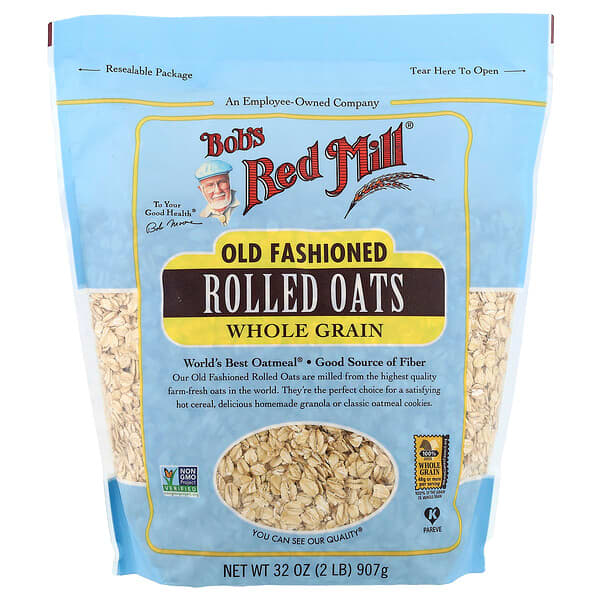
If you make oatmeal regularly, use your usual bowl size to compare this 907 g bag. At 40 g per bowl, one bag makes 22 full bowls with a little left over. Divide the price paid by 22 for an estimate, or recalculate using the amount you actually cook.
- Use the 32-ounce net package weight. If you are budgeting per breakfast, use the dry oats you actually measure into that meal.
- A lower cost per 100 g helps only if you can store and use the amount you buy.
View Bob’s Red Mill Rolled Oats details and price
NOW Foods Magnesium Glycinate (180 tablets)

NOW lists two tablets per serving, with 200 mg of elemental magnesium. A 180-tablet bottle has 90 servings. Divide the price paid by 90, then check the magnesium amount and tablet count per serving on any other bottle you’re comparing.
- The bottle contains 180 tablets. At two tablets per labeled serving, that is 90 servings. The two tablets list 200 mg elemental magnesium.
- Divide the price by 180 for cost per tablet or by 90 for cost per labeled serving.
View NOW Foods Magnesium Glycinate details and price
Vanicream Fragrance-Free Facial Cleanser (237 mL)

If you use fragrance-free facial cleanser, compare this 237 mL bottle with the size you normally buy. Divide the price paid by 237, then multiply by 100 to get the cost per 100 mL.
- The package contains 237 mL. Divide the price by 237 and multiply by 100 for a price per 100 mL.
- Texture and the amount you tend to dispense can still affect how long a bottle lasts.
View Vanicream Fragrance-Free Facial Cleanser details and price
A cost per 100 mg example
When two supplements list different amounts of the same ingredient, cost per serving can conceal a difference. Suppose the first costs NT$12 per serving and the panel lists 300 mg of an ingredient. Divide 12 by 300, then multiply by 100. The result is NT$4 per 100 mg. If a second costs NT$10 per serving and provides 200 mg, its result is NT$5 per 100 mg. The second serving costs less in cash, but the first costs less for the same labeled quantity.
That calculation only works if the ingredient and units match. If one product gives the mass of an entire compound and the other lists the amount of an element within it, use the elemental amount in both. If one is a blend that does not give a separate amount for the ingredient, there is no reliable number to put in that calculation. For a worked example of clarifying what a panel measures, see how to read a magnesium glycinate label. For fish oil, the EPA and DHA per-serving calculator examples show why oil weight and the individual fatty acid amounts have different roles.
If you want a budget over a month, use the quantity you actually expect to use. A cost per use of NT$15 multiplied by 20 uses makes NT$300. Estimate how long an opened package lasts and decide whether buying a larger size makes sense in that time window. This is a budgeting estimate. It does not establish the amount you should take or whether two products meet the same personal needs. If you’re choosing between products with different safety warnings or ingredients you already use elsewhere, resolve those differences before using the lower price as the deciding factor.
How to avoid overestimating a discount
Record the price for the item and pack you can actually buy. A first-order offer, a subscription price, a promotional multi-buy, and a regular price can all be different. Check the cart for the message beside the code and note which items received the discount. A banner giving a possible discount does not establish what will happen to every product. If you are choosing something you expect to reorder, calculate it once with the eligible offer and once with the price you expect to pay for repeat orders.
Consider a powder you buy about every six weeks. A promotional price makes the first jar cheaper, but a regular price determines most of what you spend over several months. You might prefer the size you already finish easily even if a bigger jar has a slightly better cost per gram. Compare the ingredient, the size and the expected number of uses before considering whether to change the order from the one you planned.
Check the final quantity and units again if you switch between one-time purchase and recurring delivery. If a promotion disappears when another item is removed, recalculate. Our iHerb promotion-code guide shows where to check whether a discount is actually applied.
Save a short note you can use next time
Keep five figures for each item: its exact pack size, amount per serving, number of servings, post-discount price, and any portion of shared charges. You can add one more entry for the unit that matters, such as price per 100 grams. Make a second line for price after shipping instead of replacing the product comparison with a figure you cannot reconstruct later. If you are comparing food, also note whether the stated weight is dry, drained or prepared. When a container has liquid that you discard, the usable quantity may not be the same as its headline net weight.
Start with the product you are most likely to buy. Check whether it fits the conditions you care about and whether there is a sensible alternative. Then compare those two. This keeps the work proportionate: an exact calculation for a product you cannot use is much less helpful than a rough range for two that fit. If the values are close, checkout differences, storage and how much you finish may matter more than the final decimal place.
Frequently asked questions
Can I divide by the number of pills?
Yes, if you mean cost per pill. For cost per serving, use the number of pills in a serving shown on the label. A 90-capsule bottle with three capsules per serving has 30 servings. Keep the label terminology intact so it is clear which figure you are reporting.
Should I include taxes and delivery in the cost of the product?
Add the amounts shown for the appropriate checkout if you want a delivered cost. If you only want to compare the item price, ignore those amounts for all products in that comparison. Note the choice so the result remains interpretable if you check back later.
How do I compare a liquid with a tablet?
Choose a unit both labels share. If you are comparing an ingredient, use the amount of that ingredient per measured serving or dosage unit, provided it is disclosed in the same units. If the liquid only gives an amount per tablespoon, keep the volume measure as listed or convert it carefully before comparing. You should also consider whether the liquid’s storage and use directions fit.
Is a bigger package always a better buy?
It may cost less per unit if you will finish it. Use the number of portions you actually expect to use if waste, storage or expiration is a concern. A small package is sometimes the more useful first purchase because it lets you see whether you like the preparation or texture.
What if I won’t know the final discount until checkout?
Use the regular price for your first comparison and record a second scenario for any conditional offer. Replace the estimate with the eligible discount displayed on the checkout screen before placing the order. The same approach works with expected delivery charges.
Can I compare price per 100 mg for different active ingredients?
Use that figure for the same ingredient measured in the same way. A lower price per 100 mg cannot establish that two different ingredients have the same purpose, evidence, or label instructions. Compare suitability first, then do the cost math.